






We're a bouldering gym, so you might be surprised to find us writing about lead climbing. But we get asked about ropes constantly - where to learn, where to go, whether a rope automatically means a softer landing than a crash pad. That last assumption deserves a real answer, because the physics say something most new climbers have never heard: the quality of a lead fall depends almost entirely on how much rope is in the system. And that makes wall height a safety spec, not just a bragging right.
A catch is only as soft as the rope is long
Dynamic climbing ropes are designed to stretch. They're the shock absorber of the whole system, and like any shock absorber, more of it does more work. Petzl's fall factor theory - the industry's standard reference - defines fall severity as the ratio of fall length to rope length: the longer the rope you're falling on, the more energy it absorbs, and the lower the impact force on your body. Same fall, different height on the wall, completely different catch.
High on a tall wall, a leader falling ten feet onto sixty feet of rope barely feels the stop. Low on any wall, the same climber has only a few feet of rope out, so there's almost nothing in the system to absorb the fall. The rope comes tight fast and hard.
The first three clips are the hard part
This is why lead belaying is taught in two modes. Cornell Outdoor Education's lead climbing overview puts it plainly: "For the first few clips, a harder catch is required to reduce the risk of groundfall. Above the 3rd or 4th clip, a soft catch is necessary to reduce the forces acting on the climber's body after a fall."
Read that again: soft catches begin above the third or fourth clip. Below that, the belayer's one job is keeping you off the ground, and the hard catch that requires is the trade-off - less falling, more force.
The arithmetic behind the groundfall risk is worth seeing once. As Climbing Magazine's breakdown of fall physics lays out, a lead fall isn't just the distance back to your last bolt. You fall twice your height above the clip, plus the slack in the system, plus rope stretch, plus the three-ish feet from your tie-in point down to your feet. Clipping at head height above the third bolt of a short wall, that stack of numbers eats most of the distance to the floor. It's why learn-to-lead instruction treats the early bolts of every route as the zone where falls are not part of the plan.
Now put that on a short wall
Here's where height stops being abstract. Indoor lead bolts are spaced roughly every four feet. On a 45-or-50-foot wall, clips one through four are the tense opening act of a long climb - the soft-catch zone is most of the route.
On a wall in the 18-to-24-foot range, there is no route past the fourth clip. The wall ends where soft catches begin. Every foot of every climb sits in the zone Cornell describes - hard catches only, groundfall the primary concern, the rope doing the least work it will ever do. You can bolt a line up a wall that height and call it lead climbing, and technically it is. What it can't be is the version of lead climbing where falling is routine, practiced, and soft - which is the whole reason climbers fall in love with the discipline.
That's the real logic behind the industry's height standards for roped facilities - the 35-to-45-foot figure isn't about looking impressive. It's the minimum canvas for lead climbing to work the way it's designed to.
Where that leaves us - and you
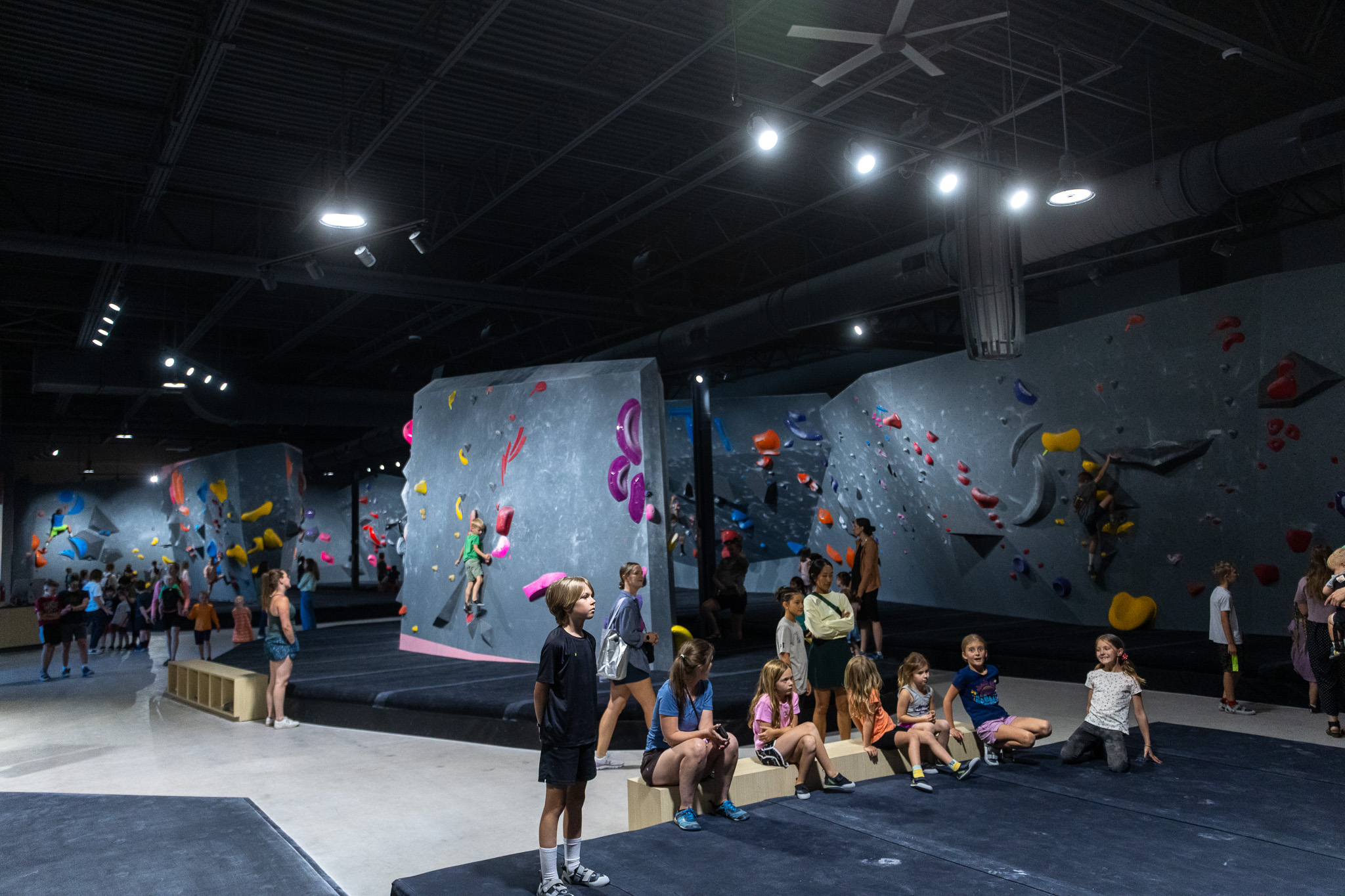
Shift doesn't have a lead wall, and this post is the reason we never bolted one onto our building: we weren't willing to offer a version of the discipline the physics can't support. We built the tall end of bouldering instead - 16-to-17-foot walls over a foot of engineered flooring, where falling is designed into every single climb and nobody's catch depends on clip number.
If lead is what you're after, we mean it when we say go get it - on walls built for it. Planet Rock in Grand Rapids runs to 50 feet and Inside Moves in Byron Center to 34, and both will teach you to clip, fall, and catch properly. Then come boulder with us on the days you want to climb hard without a partner, a rack, or a rope. Most of the strongest lead climbers in West Michigan do exactly that.
