




The Facility
We get asked about our building a lot - how big, how steep, how tall, and (every July) whether we have air conditioning. Fair questions! Here's every number, measured and in one place.
The numbers, plainly
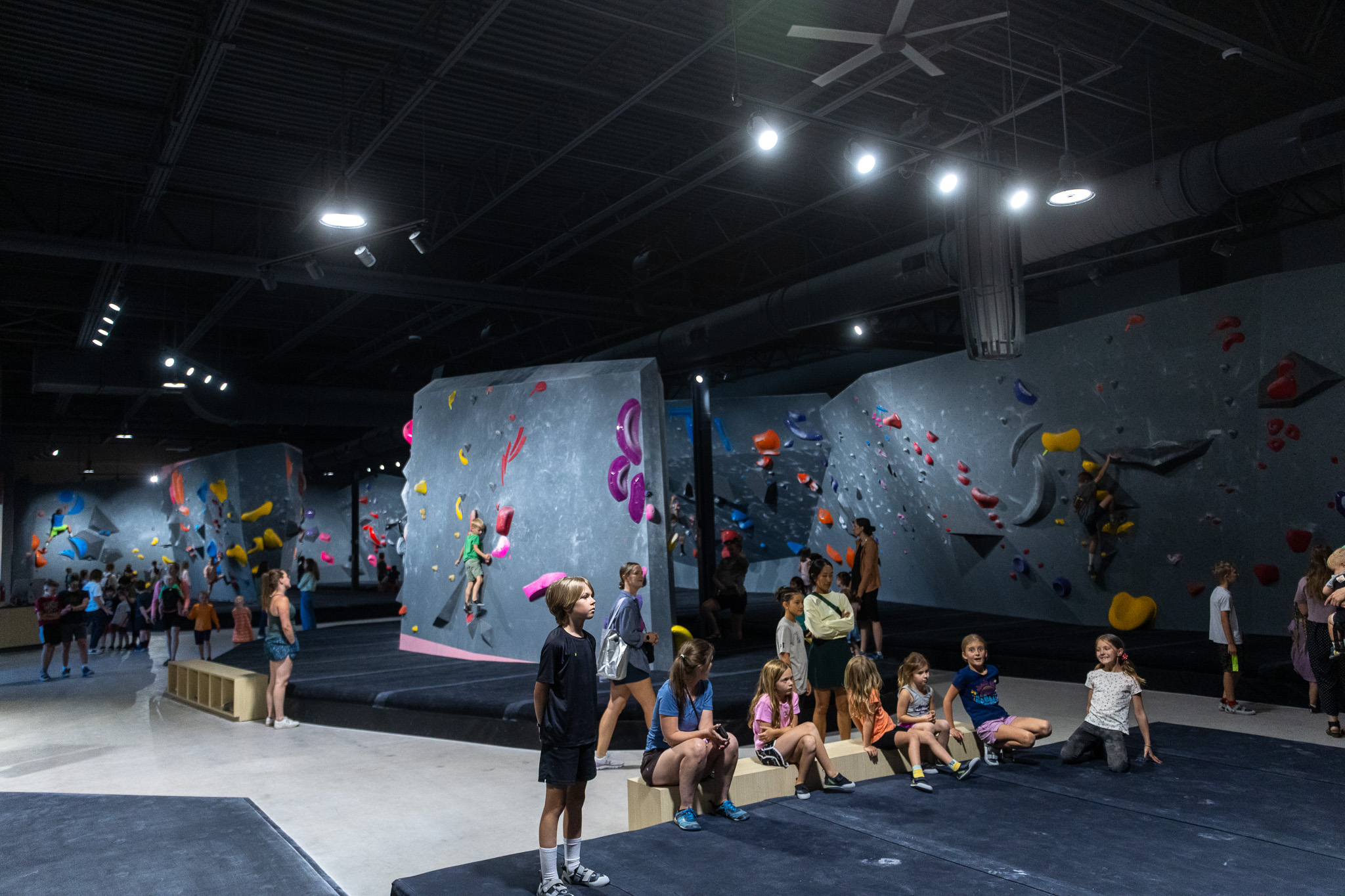
- 12,250 square feet of facility - the largest climbing gym in Holland, Michigan.
- 5,274 square feet of fixed climbing surface - that's the wall area you actually climb on, straight from our structural engineering drawings.
- Over 6,500 square feet of effective climbing terrain - because one of our boulders moves (more on that below), the same walls give you more distinct climbing than their fixed surface suggests.
- Fully air conditioned, year-round. Climbing in a Michigan July should still be fun. Chalk stays dry, holds stay grippy, and you stay a functioning human being.
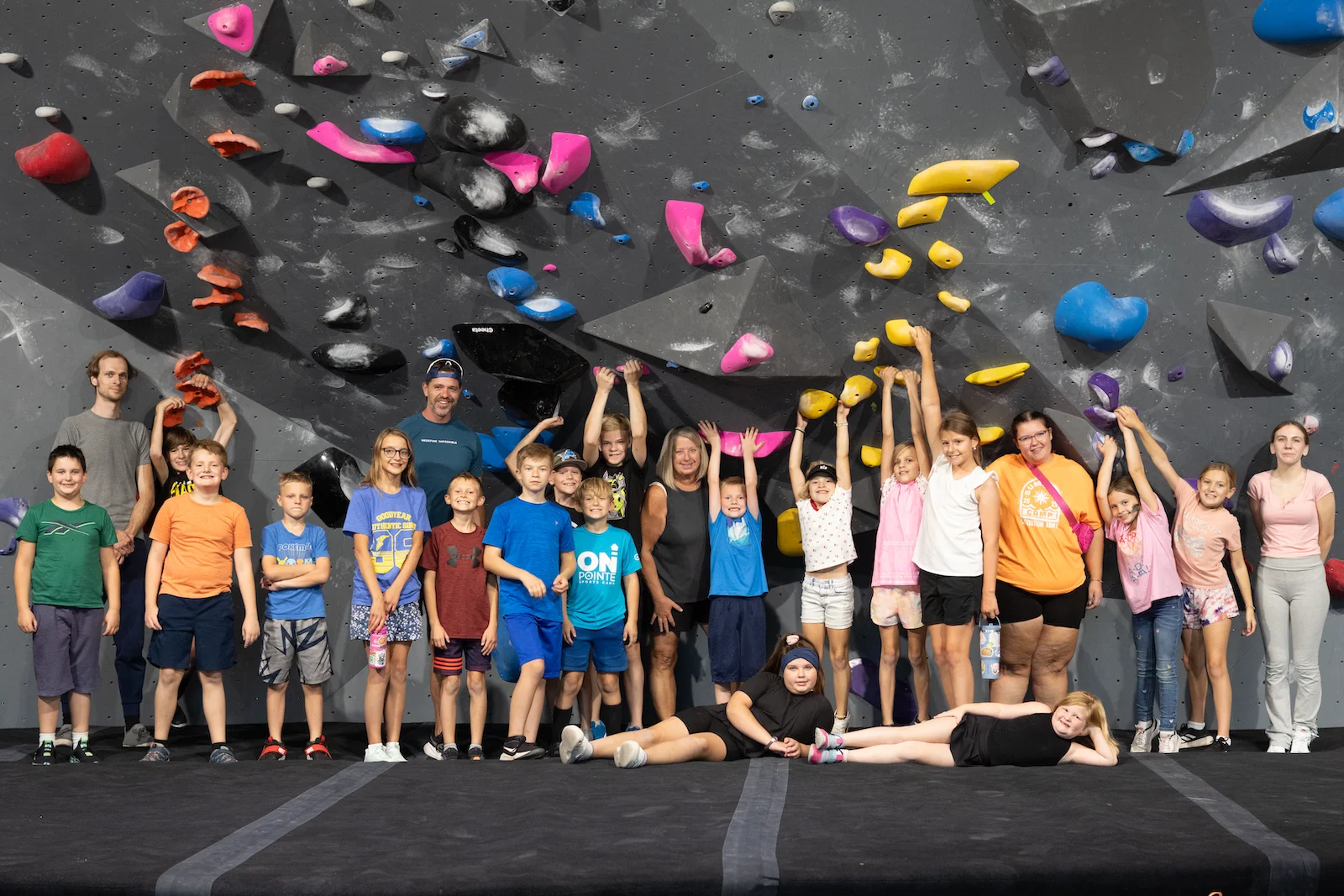
- Walls run 16–17 feet tall over thick padded flooring - no ropes, no harnesses, nothing to clip. Climb up, climb down, or land on the pads.
The steep wall: 61 feet wide, 45 to 60 degrees
Our overhanging wall is 61.4 feet wide and 16 feet tall, moving from 45 degrees to 60 degrees across two sections. (An overhang, if you're new here, is a wall that leans out over your head - the steeper the angle, the more your whole body has to work.)
Width is the number that matters most on steep terrain. Steep climbing eats wall space quickly, so a narrow overhang only has room for a handful of climbs at one difficulty. Sixty-one feet is enough real estate to run easy circuits, moderate circuits, and genuinely hard climbs on the same angle at the same time. For scale: the widest standard commercial training board made is 16 feet wide. Ours is nearly four times that, before you count the board (below).
If you've never climbed steep terrain, don't let the angle scare you off - we set easy climbs on it deliberately, with big friendly holds. Falling on an overhang means falling away from the wall onto flat padding, and most new climbers find it less intimidating than they expected. It's also where you'll learn the most about how climbing actually works.
The boulder that moves
Our hydraulic boulder tilts - from vertical to 13 degrees left to 13 degrees right - and we set it to be climbed in all three positions. Same holds, three different climbs. It's the reason our "effective terrain" number is bigger than our wall area: one structure does the work of three.
We're not aware of another gym in Michigan with one. Come pull on it and you'll see why we bothered.
The Tension Board 2
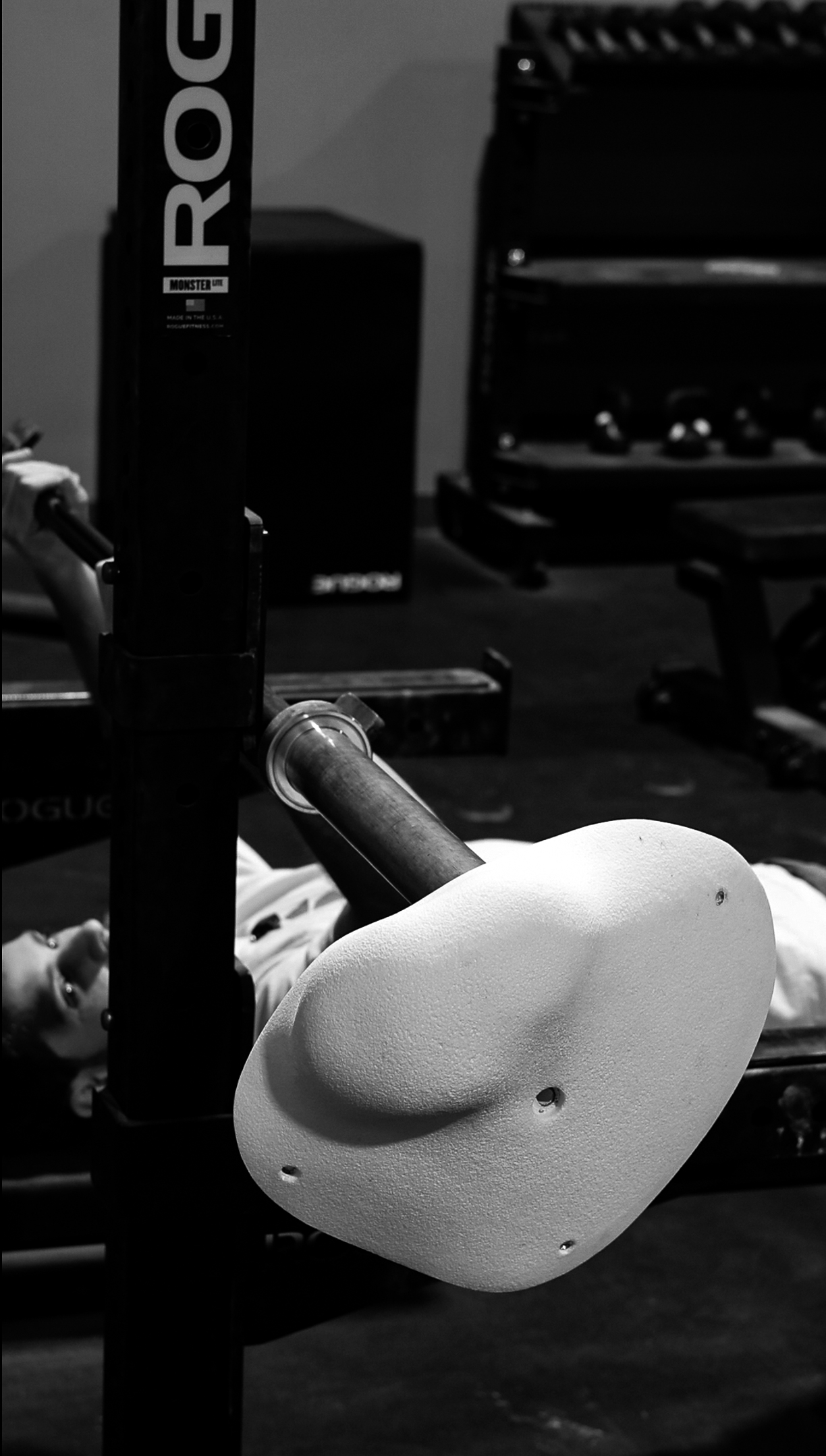
For climbers chasing strength, our Tension Board 2 (TB2) is a standardized, adjustable-angle training wall connected to an app with thousands of benchmarked problems. Set it to your angle, pick a problem, and measure yourself against climbers worldwide. It sits in our dedicated training area alongside a hangboard station and a Rogue fitness setup.
What's under your feet
Falling is part of bouldering, so we engineered for it:
- 4,348 square feet of continuous flooring and padding across the climbing areas - 12 to 14 inches thick under the main walls, memory and polyurethane foam composite.
- Extended fall zones around every structure, including the moving boulder.
- Our walls were engineered to EN 12572-2:2017, the international safety standard for bouldering walls, with the structural design independently reviewed by a US structural engineering firm. It's a 108-page document. We're happy to talk about it at the front desk; we find it very exciting and our staff mostly humors us.
Beyond the walls
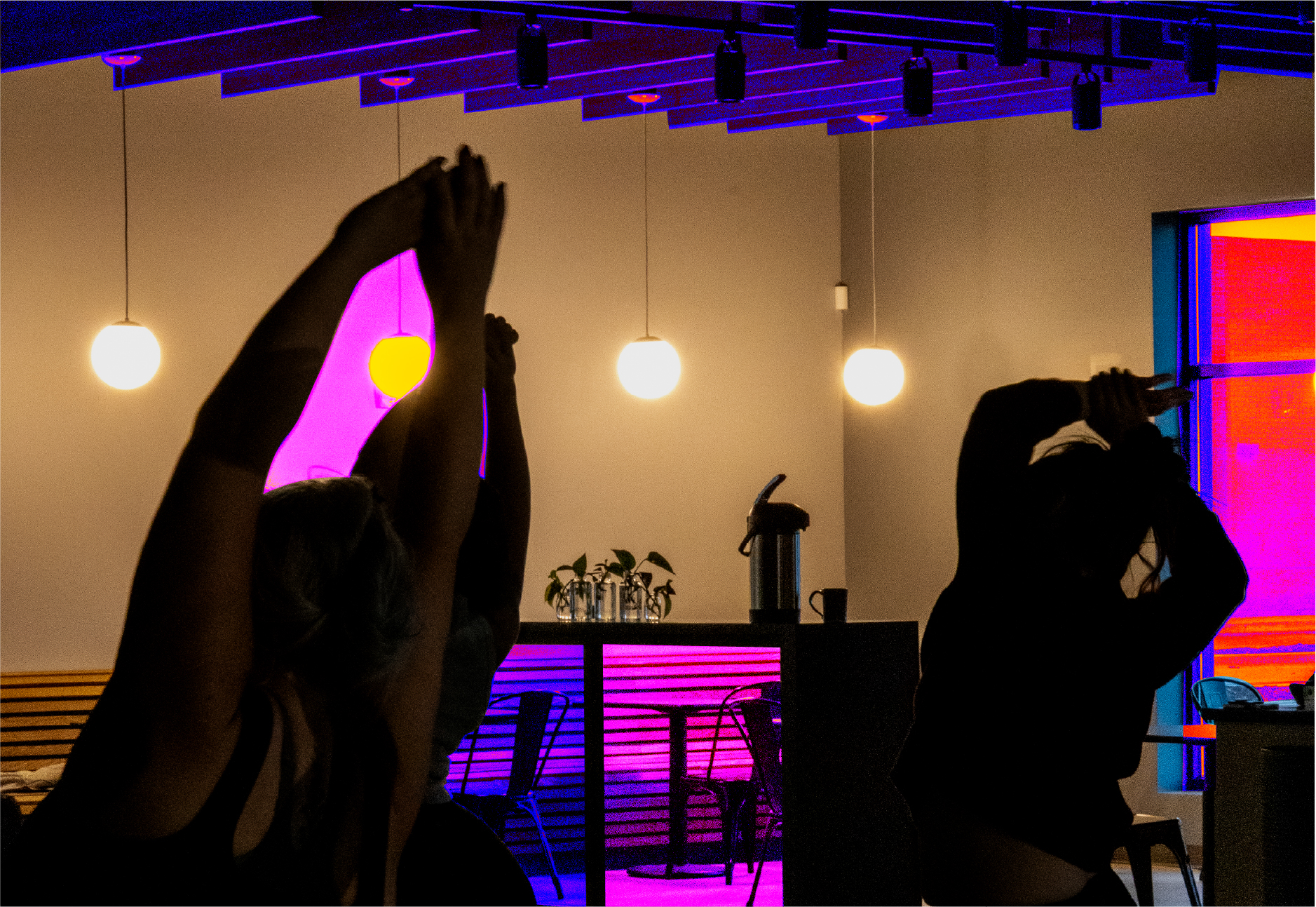
A café with real espresso (Madcap Coffee), a lounge you'd actually want to sit in, a co-work space if you need to answer emails between attempts, showers, and gear rentals - shoes and chalk are free with every day pass and membership.
Come see it
Numbers are numbers; the room is better in person. Drop in any time we're open - no reservation needed - or plan your first visit.
Every kind of terrain, on purpose
The steep wall gets the headlines, but a bouldering gym teaches through variety, and we set on every kind of terrain climbing has: slab, vertical, gentle overhangs, steep overhangs, dihedrals, and aretes. Each one asks your body a different question, and a well-rounded climber needs them all.
Slab is wall that leans back away from you - less than vertical - and we have a lot of it. It's the great teacher of footwork and balance: you can't muscle your way up a slab, you have to trust your feet, shift your hips, and stand up through your legs. Vertical terrain is the straight-up-and-down classic in between, where precise body positioning starts to matter more than pulling power.
Our gentle overhangs - sections tilted 15 to 25 degrees past vertical - are the bridge between technique and strength. They're steep enough to load your arms and core, but not so steep that newer climbers are shut out, which makes them the best place in the gym to build the body tension that steeper climbing runs on.
Dihedrals and aretes are the corners of climbing, and we set multiples of both. A dihedral is an inside corner, like the crease of an open book: it teaches stemming - pressing your feet against opposing walls - and creative resting. An arete is the opposite, an outside edge you climb by wrapping and squeezing: pure compression and body control. Corners force you to think in three dimensions, and the movement they build shows up everywhere else on the wall.
Why we went all-in on bouldering (and where to go for ropes)
Shift is a bouldering gym on purpose. Our walls top out at 16 to 17 feet over 12 to 14 inches of engineered padding - the height the discipline is built for, where every climb ends with a safe step or drop to the floor and nobody needs a harness, a belay lesson, or a partner.
Roped climbing is a different discipline with different requirements, and the biggest one is height. The industry's own standards put the bar high. Commercial design guides call 35 to 45 feet the standard for a dedicated roped facility. EP Climbing, one of the world's largest wall builders, classes top-rope and lead walls at 30 to 60 feet and bouldering walls at 10 to 20. Site-selection guidance for new gyms calls for 8 to 15 meters of wall. And industry height guides class 14-to-24-foot roped setups as recreational amenities for rec centers, YMCAs, and hotels rather than dedicated sport climbing. Below roughly 35 feet, a roped wall can't hold a true progression: you run out of wall before the climbing gets interesting.
For roped climbing in the ideal height range, we recommend Planet Rock in Grand Rapids, with walls up to 50 feet, and Inside Moves in Byron Center, with top-rope and lead climbing to 34 feet. Come boulder with us. Go clip bolts with them. Plenty of West Michigan climbers do both. And if you want the full physics of why height matters on lead, we wrote it up.
Beyond the walls
Every entry includes more than climbing. Our dedicated strength and fitness zone runs a full Rogue setup - free weights, racks, and cardio equipment - so a training day never requires a second gym membership.
Shift Cafe pours locally sourced coffee - espresso, pourovers, cortados, chai and matcha lattes, and kombucha on tap - alongside curated snacks. It doubles as a co-working space with complimentary wifi and plenty of table room, and plenty of our members split a day between the laptop and the wall.
The practical details are covered too: three unisex bathrooms, a full shower for lunch-break sessions, and free shoe and chalk rental with every entry. And the whole building is immaculately kept - daily cleaning rhythms cover the mats, the holds, the cafe, and the bathrooms, because a clean gym is something you feel the moment you walk in.
Easy to get to from anywhere on the lakeshore
We're centrally located just off James Street and US-31 - minutes from downtown Holland and Zeeland, and a straight highway shot from Grand Haven, Saugatuck, and Fennville. If you live anywhere on the lakeshore, we're likely the easiest climbing to reach: quick highway access, no downtown parking hunt, and a big lot at the door. Hours and directions here.
And we're open when others aren't. Our doors open at 6:00 AM on Tuesdays and Thursdays - the only climbing gym in the Holland area with early morning hours - because the community asked for a place to climb before work and school, and we're proud to be it. Full hours here.
FAQ
What's the steepest wall at Shift?
Our overhanging wall reaches 60 degrees at its steepest section, transitioning from 45 degrees across a 61.4-foot width - wide enough for beginner circuits and hard climbs on the same angle.
How much of the gym is overhanging?
The 61-foot steep wall plus the tilting boulder and TB2 give us more steep-terrain variety than any gym in the area - with easy climbs set on all of it, not just hard ones.
Are there beginner climbs on the steep walls?
Always. Our circuit system guarantees it: you'll find climbs from our easiest colors on the overhang every set cycle. Steep climbing on good holds is one of the fastest ways to learn real technique.
How often do you set new climbs?
Our routesetting crew strips, washes, and resets sections weekly, so there are new climbs essentially every time you visit. Meet the setting team.
Does Shift Climbing have air conditioning?
Yes - the whole facility, all year. If you've climbed elsewhere in a West Michigan summer, you know exactly why we're mentioning it.
How tall are the walls?
16–17 feet, over 12–14 inches of engineered padding. No ropes or harnesses anywhere in the gym - this is bouldering.

Hours
Sunday
10am
-
6pm
Monday
10am
-
10pm
Tuesday
6am
-
10pm
Wednesday
12pm
-
10pm
Thursday
6am
-
10pm
Friday
10am
-
10pm
Saturday
8am
-
8pm
© 2024 Shift Climbing
Privacy Policy