




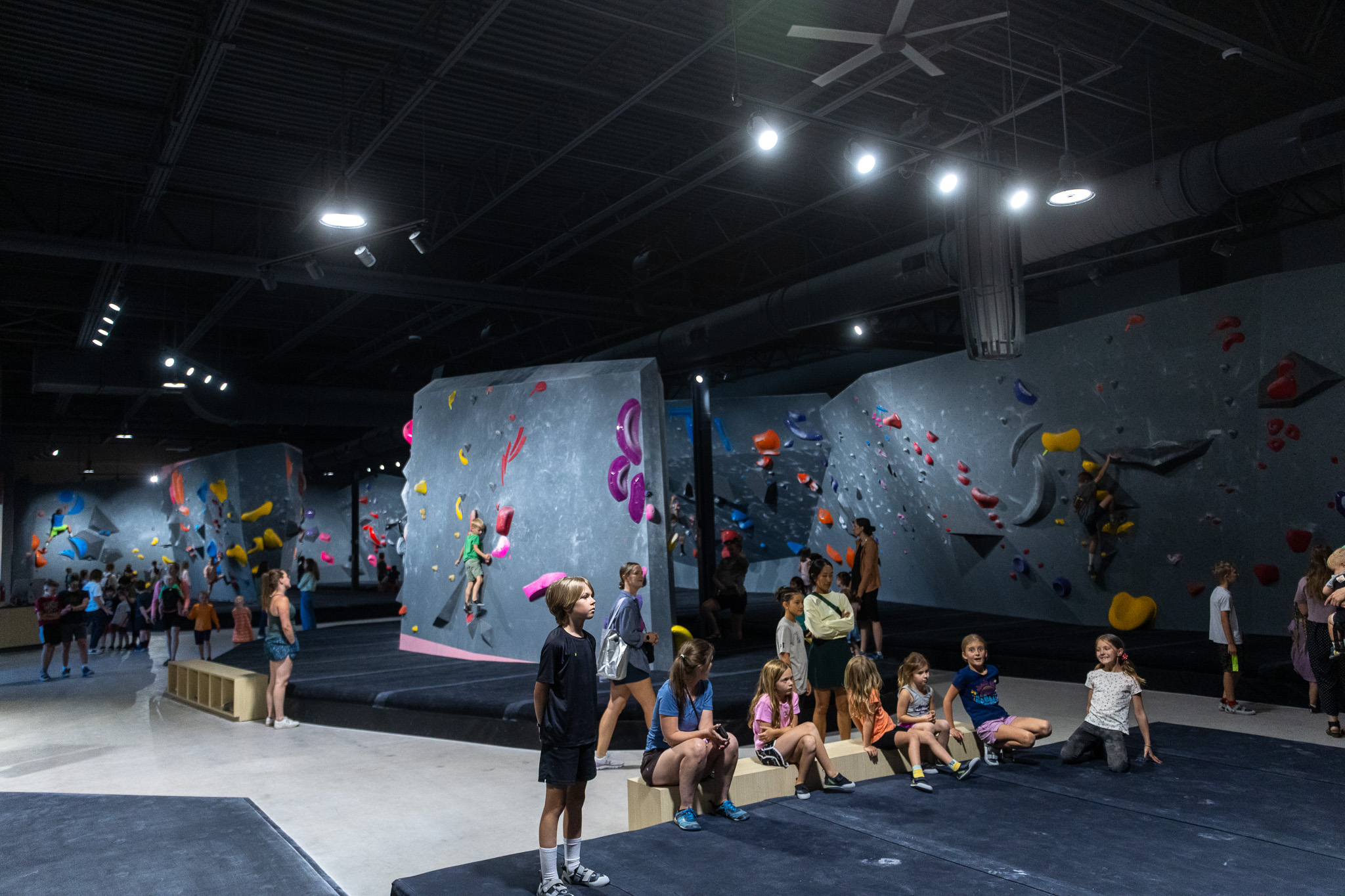
Ask a climber about a gym's steep wall and they'll usually ask one question back: how steep? It's the wrong first question. Nearly every gym has an overhang. What almost no gym has is a wide one - and width, it turns out, is the number that decides what a steep wall can actually do for your climbing.
Ours is 61.4 feet wide and 16 feet tall, moving from 45 degrees to 60 degrees across two sections. Here's why we built it that way.
Steep climbing eats space
An overhang (a wall that leans out over your head) uses up wall real estate fast. Climbs on steep terrain sprawl - your body swings wide, the holds spread out, and each climb needs elbow room so climbers aren't landing on each other. On a narrow steep wall, that math is brutal: a 20-foot-wide overhang has room for maybe six or seven climbs, and they'll all live in a similar difficulty range, because that's all that fits.
Which means at most gyms, the steep wall is a corner for the strong. If you can't already climb hard, it has nothing for you.
What 61 feet buys you
Width turns the same angle into a whole neighborhood. Across 61 feet we can run our easiest circuit colors, our middle circuits, and genuinely hard climbs on steep terrain at the same time - and reset sections of it weekly without the wall ever going "empty." In practice:
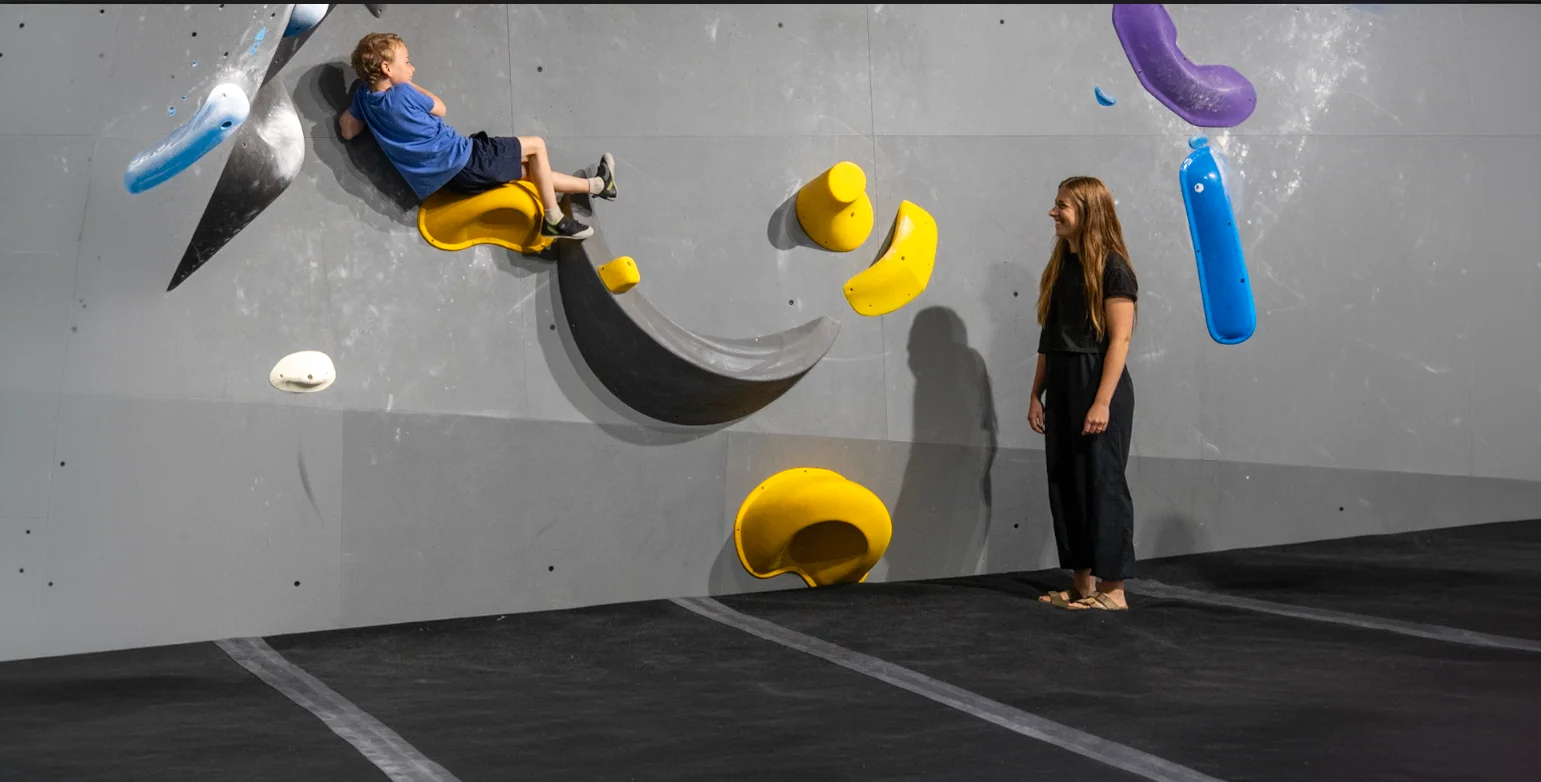
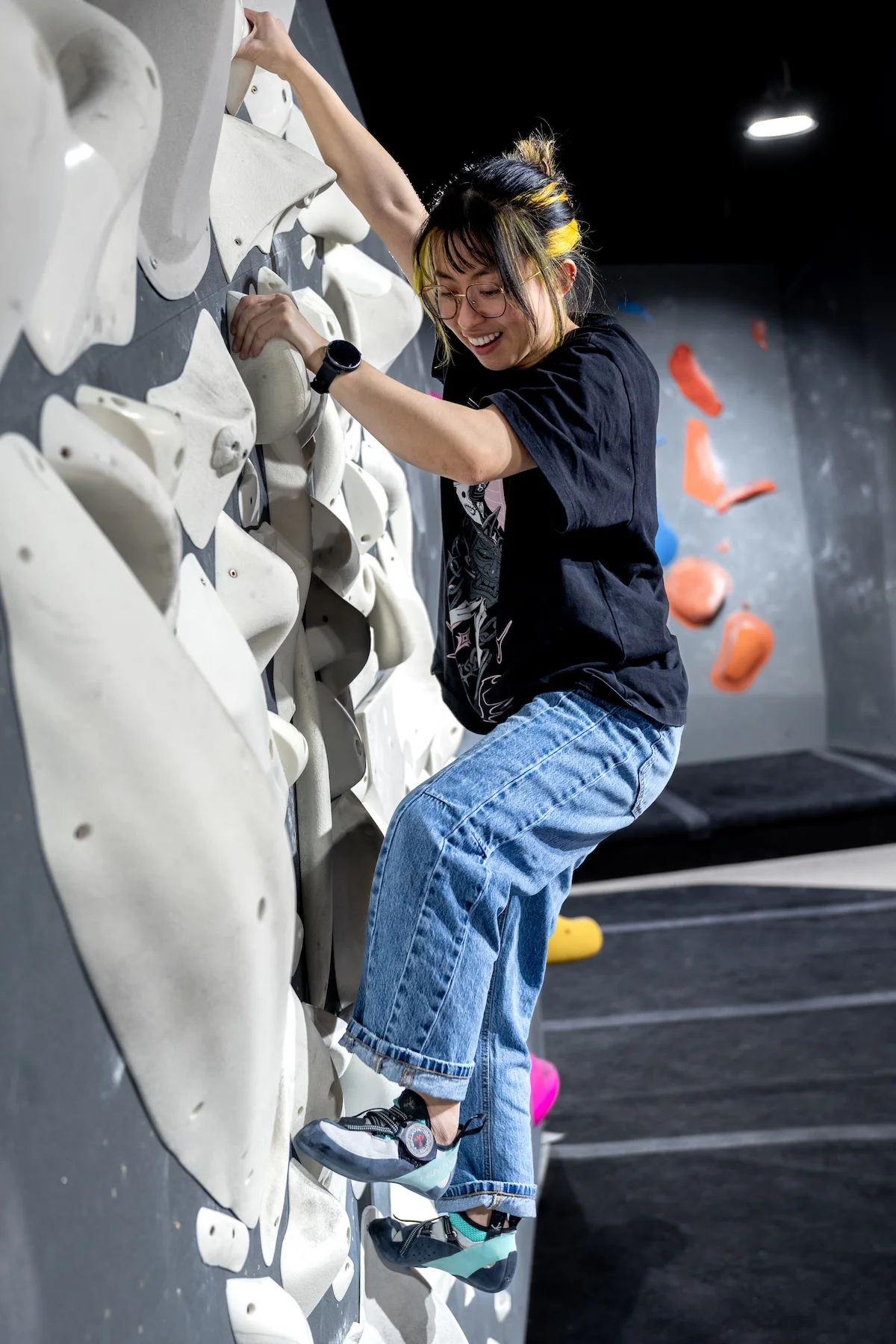
- First-timers climb steep here. We set big, friendly holds on the overhang deliberately. If you've never climbed before, some of your first-day climbs will be on this wall - and they'll probably be your favorites.
- Two angles, one wall. The 45-degree section and the 60-degree section climb like different worlds. You can feel your body figure out the difference in a single session.
- Nobody queues. A wide wall holds a Friday-night crowd. A narrow one holds a line.
For a sense of scale: the widest standardized commercial training board made is 16 feet wide. Our steep wall is nearly four times that - and that's before our Tension Board 2, which lives in its own training area.
Why steep is where you learn
Here's the counterintuitive part: overhangs are where technique gets built. On a vertical wall, you can muscle through with your arms and get away with it. Lean the wall over your head and that stops working - your hips, feet, and core have to join the conversation. Coaches send climbers to steep terrain to learn body tension for exactly this reason (The Climbing Doctor has a good breakdown).
And falling? On an overhang you fall away from the wall, onto flat padding - at Shift, onto 12 to 14 inches of engineered foam. A 2025 study of bouldering injuries found the typical injury scenario is a feet-first landing from a vertical wall; only a small fraction of reported falls happened on roofs and steep terrain. Steep walls look scarier from the ground than they feel on the pads.
And then there's the boulder that moves
Sixty-one feet wasn't enough steep variety for us, so one of our freestanding boulders is hydraulic: it tilts from vertical to 13 degrees left or right, and we set it to be climbed in all three positions. Same holds, three climbs. On a slow Tuesday you can watch someone finish a climb, tilt the world, and try it again as a different problem.
Come feel the difference
The whole argument above takes about one session to verify. Find the yellow holds on the overhang, climb to the top, and notice what your feet just learned. Plan your first visit - the steep wall is friendlier than it looks, and it's waiting.
