





Routesetting at Shift
The single biggest difference between climbing gyms isn't square footage or shiny equipment. It's the climbs. Routesetting - how our climbs get designed and put on the wall - is the product, and it's the thing we obsess over most.
Who sets your climbs
Our routesetting program is led by Jonathan Brandt, a Shift owner and a routesetter certified to USA Climbing Level 5 - the organization's highest routesetting certification (Climbing Magazine interviewed him at that level during the Tokyo Olympics). Getting there requires forerunning 5.14 and V9+, chief-setting championship-level competitions, and years across national events; Jonathan has served as Chief Routesetter for lead climbing at USA Climbing's Adult National Championships and appears in USA Climbing's official national routesetter assignments. He's been setting for nearly two decades, and he'd still rather talk about your project than his resume.
Why does a certification matter for your Tuesday-night session? Because setting at that level is a trained craft: reading movement, controlling difficulty precisely, and building climbs that teach you something instead of just tiring you out. Most gyms don't have anyone within three certification levels of this in the building. We have him on the ownership team, on the floor, driving every set.
He doesn't set alone. Shift keeps a certified crew on staff: Jack Murphy, our head routesetter, and Zac Kitay set full time, and Matt Bradley sets part time - all three certified USA Climbing Level 1 routesetters. That's four USA Climbing-certified setters on the floor of one bouldering gym, which is how the walls get stripped, washed, and reset every week without the quality ever dipping.
The philosophy: movement over power
Our setting follows a school of thought pioneered by setters like Tonde Katiyo, one of the most influential routesetters in the sport (hear him on The Nugget podcast). The core idea: a great climb is a puzzle for your whole body, not a strength test for your fingers. Body position, balance, momentum, a little creativity - the moves should make you think "huh!" before they make you tired.
That philosophy is why beginners at Shift tend to come back. Climbs built on movement are interesting at every level. Climbs built on brute difficulty are only interesting if you can already do them.
Circuits, not V-grades
Walk into most gyms and every climb has a number on it - V0, V4, V7 - and the number quietly becomes the whole sport. We do it differently, and it's on purpose.
Our climbs are organized into circuits: groups of climbs identified by hold color, with each color covering a difficulty range. The idea comes from the legendary bouldering circuits of Fontainebleau, France, the birthplace of the sport. You find your color, and the gym becomes a trail map: work through the circuit, celebrate the ones you finish, wrestle with the ones you don't.
What that means in practice:
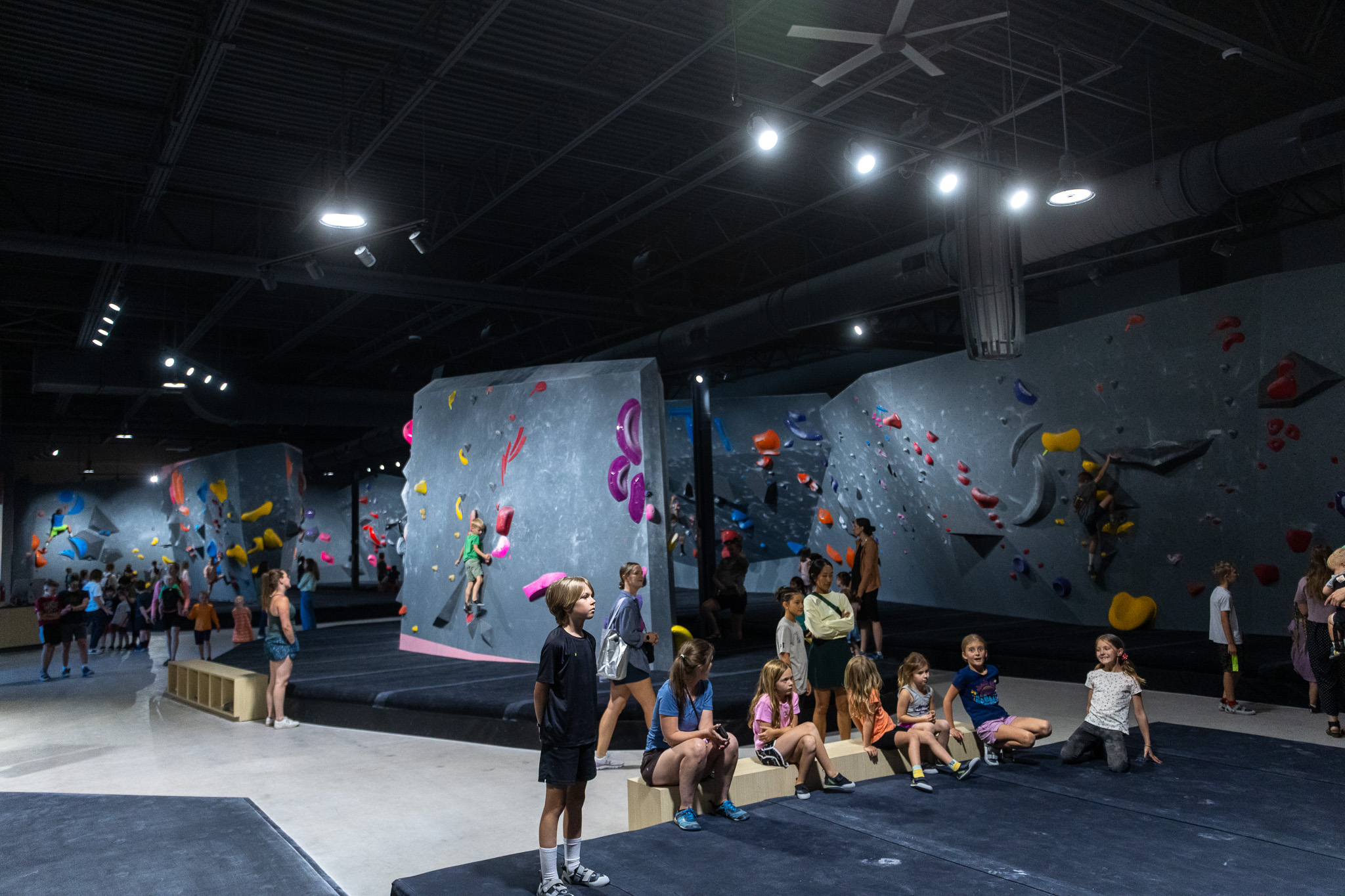
- At any given time, we keep 8–10 climbs each in our four most accessible colors - 30 or more climbs a first-time climber can genuinely succeed on, on day one. Not four. Not "one easy one over in the corner." Thirty-plus, spread across the whole gym, including the steep wall.
- Nobody asks what you climb. There's no number to compare, so people compare beta (climber-speak for how you solve a climb) instead. It changes the whole room.
- Progress feels like progress. Finishing a full circuit - "circuiting" - is one of the most satisfying goals in climbing, and you can chase it from your very first month.
Fresh climbs, weekly
The crew strips sections down to bare wall, washes every hold, and sets new climbs on a weekly cycle. The gym you visit this week is not quite the gym you visited last week. That's the point - a constantly renewing set of puzzles is what keeps climbing fun for year three the same way it was fun on day one.
Come try the product
Every word above is testable in about twenty minutes on the wall. Plan a first visit or just come by - someone on the floor will point you to your first circuit.

Hours
Sunday
10am
-
6pm
Monday
10am
-
10pm
Tuesday
6am
-
10pm
Wednesday
12pm
-
10pm
Thursday
6am
-
10pm
Friday
10am
-
10pm
Saturday
8am
-
8pm
© 2024 Shift Climbing
Privacy Policy