






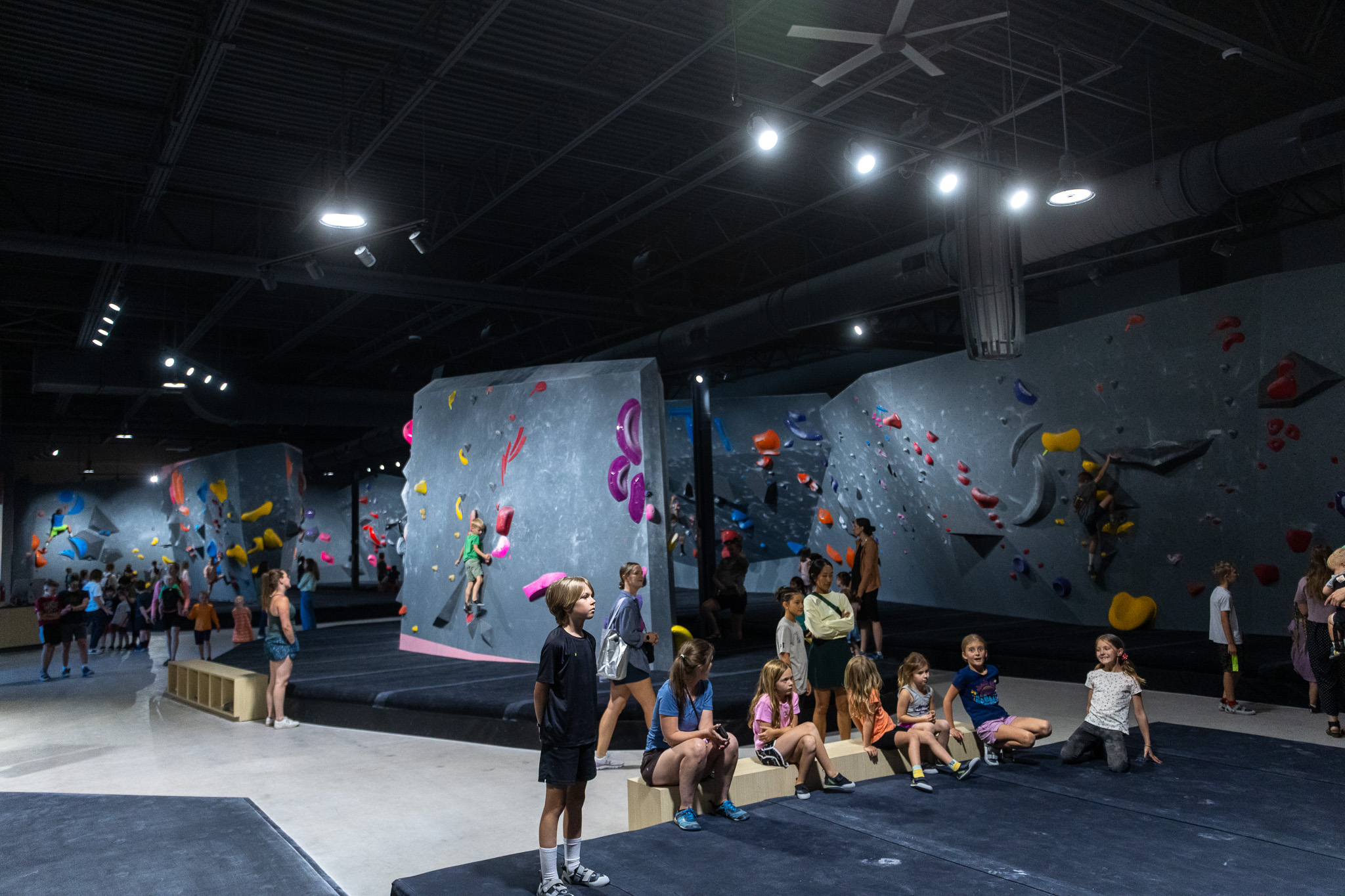
At Shift, we want you to feel comfortable before you start climbing. You don’t need a background or history in climbing to understand how our gym is laid out because everyone is given a welcome tour the first time they step into the facility.
This guide breaks down the three essential elements of any bouldering wall, including the holds, the angles, and the circuit system. We wrote this so you can confidently decipher the room and choose the perfect challenge for your session.
At a Glance: The Three Elements of a Climb
| Element | What It Dictates | Why It Matters to Your Workout |
|---|---|---|
| The Holds | Your points of contact (the colorful plastic that you climb on.) | Dictates the grip type, finger strength required, and movement complexity. |
| The Wall Angle | How steep or overhung any given wall is. | Changes the physical demand from pure balance (slabs) to full body including core and upper-body power (overhangs). |
| The Circuit | The color-coded path from one boulder to the next, meant to show difficulty of a given boulder. | Allows you to easily track your personal progress and stay within your ideal growth and challenge zones. |
1. The Holds: The Building Blocks of a climb
The plastic and fiberglass shapes secured to the walls are called holds. They are custom-shaped to mimic different types of natural rock formations. As a beginner, learning the basic shapes will help you anticipate how to grip them:
- Jug: Big, deep, cup-like holds that you can wrap your entire hand inside. These are the easiest and most secure holds in the gym, perfect for resting and warming up.
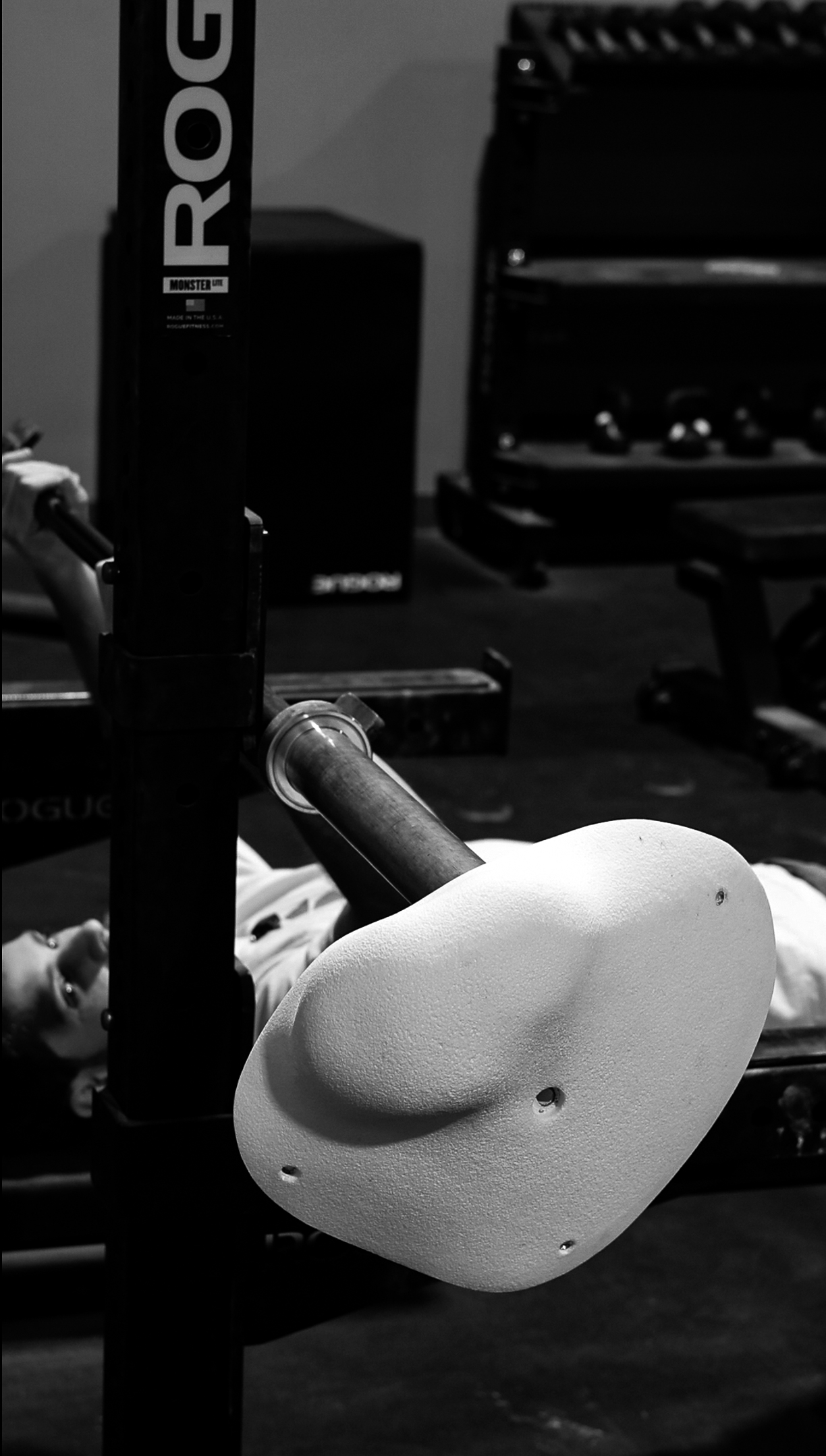
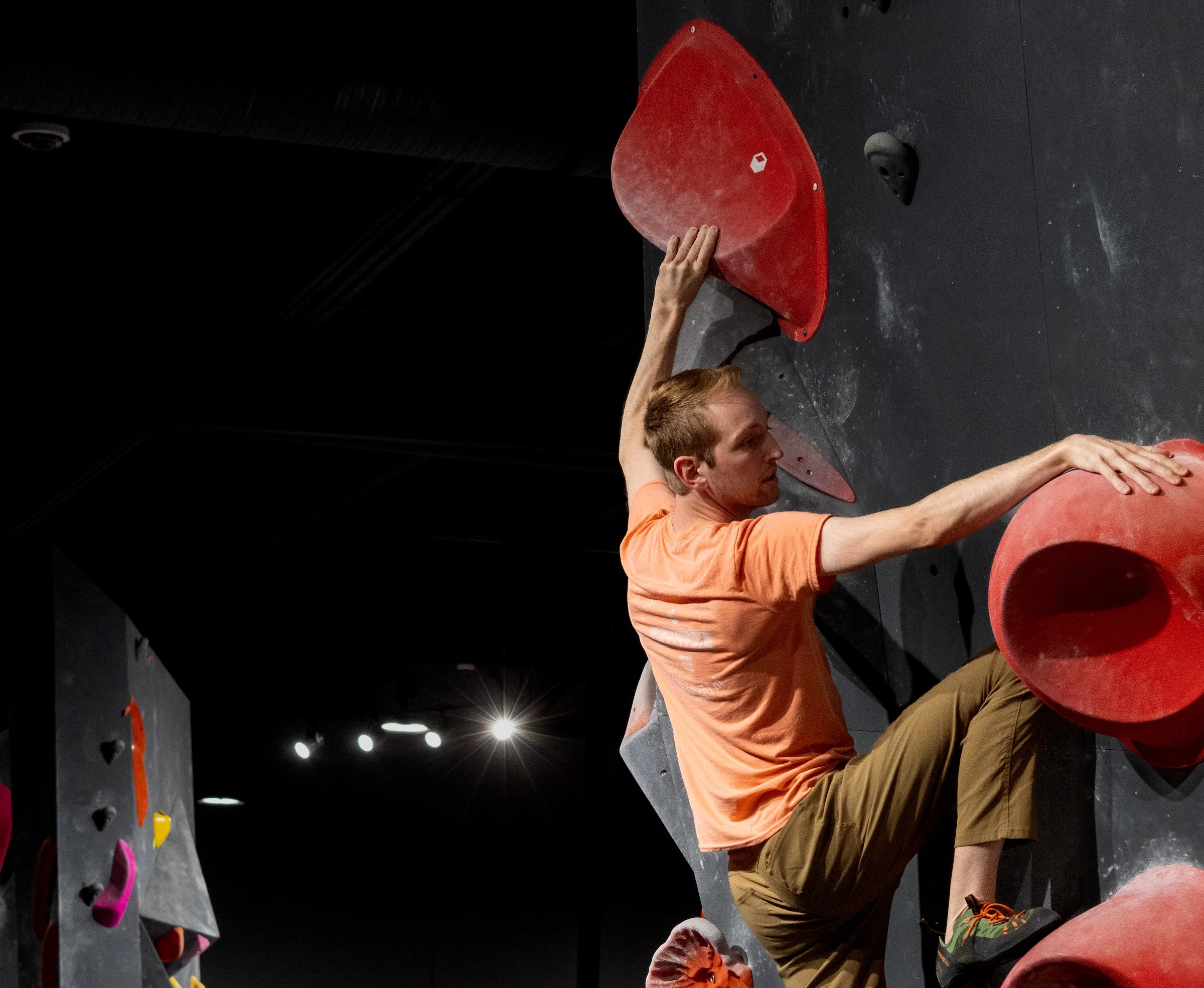
- Sloper: Large, rounded, bulbous holds with no distinct edges. You can’t "grip" a sloper with finger strength; instead, you have to maximize friction by palming the hold and keeping your body weight directly underneath it.
- Crimp: Very small, narrow edges that only accommodate your fingertips. These require deliberate finger strength and proper mechanics—like the open grip or half crimp—to manage effectively.
- Pocket: Holds featuring a distinct hole designed for only one, two, or three fingers.
- Pinch: Like the name suggests, a thicker hold that forces the climber to pinch between their thumb and the rest of their fingers. Think of holding a hamburger with one hand - that’s a sloper!
- Volume: varying sizes of geometric wooden or fiberglass structures secured to the wall that can feature smaller holds attached to them. Volumes essentially rewrite the shape of the wall, creating temporary protrusions to climb on.
2. The Wall Angles: Shifting the Physical Demand
The angle at which a climbing wall sits completely transforms the type of workout your body receives. At Shift, we feature a diverse range of terrain to target different athletic styles:
Slab Walls
- The Angle: Anything beyond lat vertical (90,) angled slightly away from you like a ramp.
- The Workout: This style can be about balance and footwork. The wall leans slightly away from you, so gravity actually helps push your body weight into the wall instead of pulling you off it. This lets your leg muscles do most of the work instead of draining your arms. It is also the perfect place to practice smearing. This is a technique where you press the rubber of your climbing shoe directly against the wall for grip when there isn't a normal foothold to step on.
Overhung & Steep Walls
- The Angle: Angled out over your head, ranging from a slight tilt to aggressive, roof-like caves.
- The Workout: This style gives your upper body and core a great workout. The wall leans out over your head, so gravity is trying to pull your hips down and away. You will need to keep your muscles tense so your feet don't swing off the holds. It’s a great place to build power and learn foot techniques.
3. The Circuit System: Navigating Difficulty
Our approach to labeling the difficulty of boulders and the journey on how you approach our climbs is called The Circuit System.
Inspired by the historic birthplace of bouldering in Fontainebleau, France, a circuit is a collection of climbs grouped within the same difficulty range. We identify circuits by the color of the holds themselves.
How to climb through a Circuit at Shift:
- Find Your Color: Instead of guessing grades, you pick a cohesive color track that matches your current skill level (e.g., all yellow holds represent beginner routes, while all blue holds represent high intermediate to advanced climbs, starting around V7/V8 and going well beyond).
- Locate the Start: Look for the yellow arrow and number (indicated by a tag or a marking on the wall) indicating a suggestion on where to start that specific climb.
- Follow the Path: The challenge could be to use only that specific color of holds for your hands and feet to navigate the climb to the top.
- The Finish: A climb is successfully completed when you securely match both hands on the designated final hold or top of the wall with complete control.
The Shift Difference: Fresh boulders, Expert Guidance
The most exciting part about a dedicated bouldering gym is that the canvas is constantly changing. Our professional routesetting crew is perpetually stripping sections of the wall bare, washing the holds, and setting entirely fresh circuits weekly. This ensures that every time you walk into Shift, there are brand-new mental and physical puzzles waiting for you to solve.
Bouldering is an independent sport where you execute the movement yourself, but it is highly community dependent. If you ever get stuck trying to read a circuit just ask someone on the mats next to you or wave over one of our staff members. We are always on the floor, ready to help you map out your path and crush your goals!
