





If you've climbed at another gym, the first thing you'll notice on our walls is what's missing: there are no grades on them. No V4 tag, no number under the start hold. Our climbs are organized into circuits by hold color, a system inspired by the legendary bouldering circuits of Fontainebleau, France, and the second thing you'll do is walk up to the desk and ask "okay, but what V-grade is the purple?" We get that question every week, and this is our answer, with one caveat up front: it's a loose correlation, it's ours, and it's built to overlap.
V-grades, briefly
The V-scale (named for John "Vermin" Sherman, who developed it at Hueco Tanks in Texas) is the grading system most American bouldering gyms use. It runs from VB (the "B" is for beginner, and some people say it "Vb" or "V-boy") through V0, V1, V2, and on up into the teens, with plus and minus signs for the in-betweens. A V2 is harder than a V1, and a V5 is a real step up from a V3.
Here's the thing about V-grades that every climber learns eventually: they are famously inconsistent. A V4 in one gym is a V2 across town and a V6 at the crag, and the grade on a climb usually reflects how the setter felt about it that afternoon. Grades are useful for tracking your own progress on the same wall over time, and a lot less useful for comparing gyms, climbers, or anything else. That inconsistency is part of why we don't put them on the wall.
Colors instead of grades
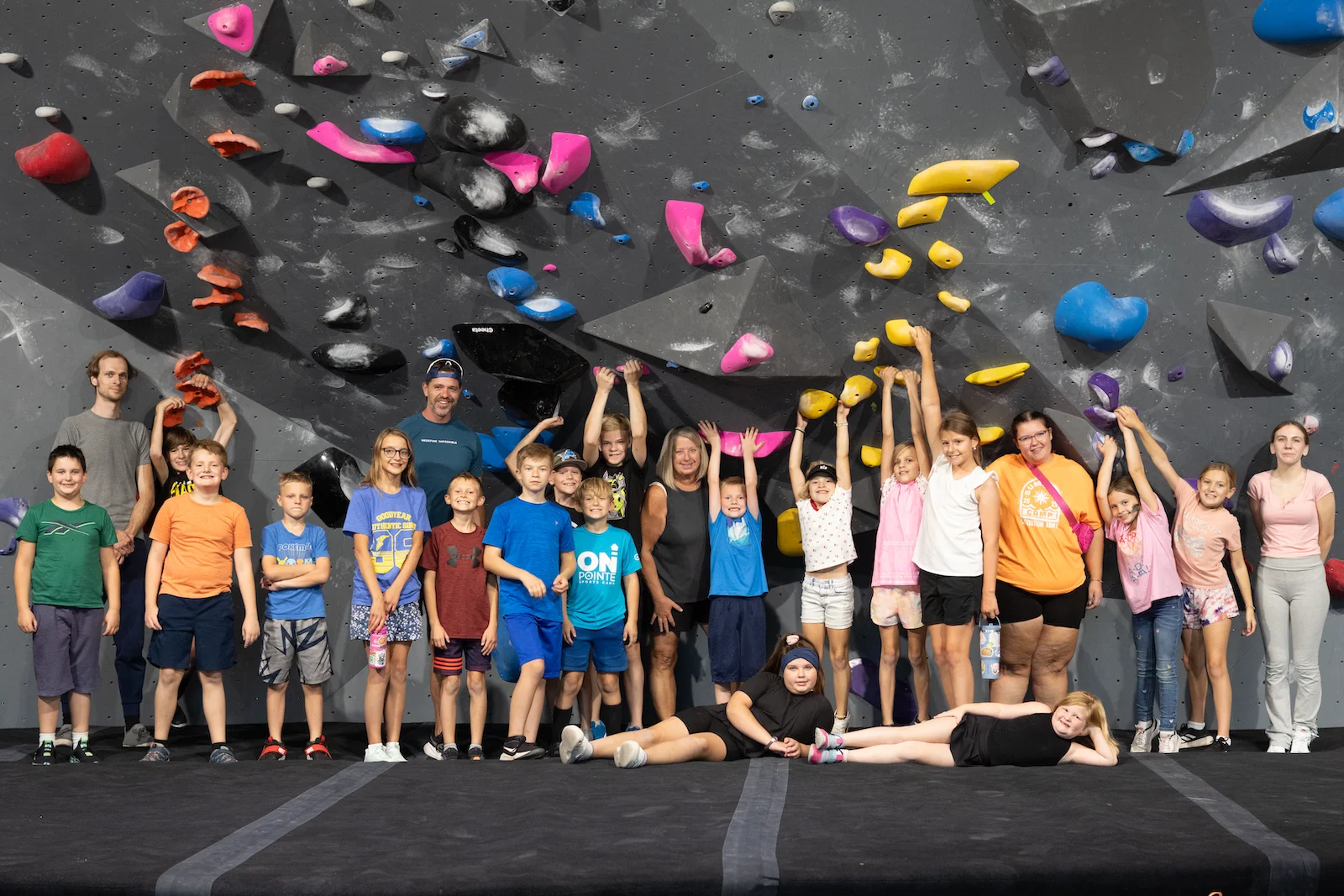
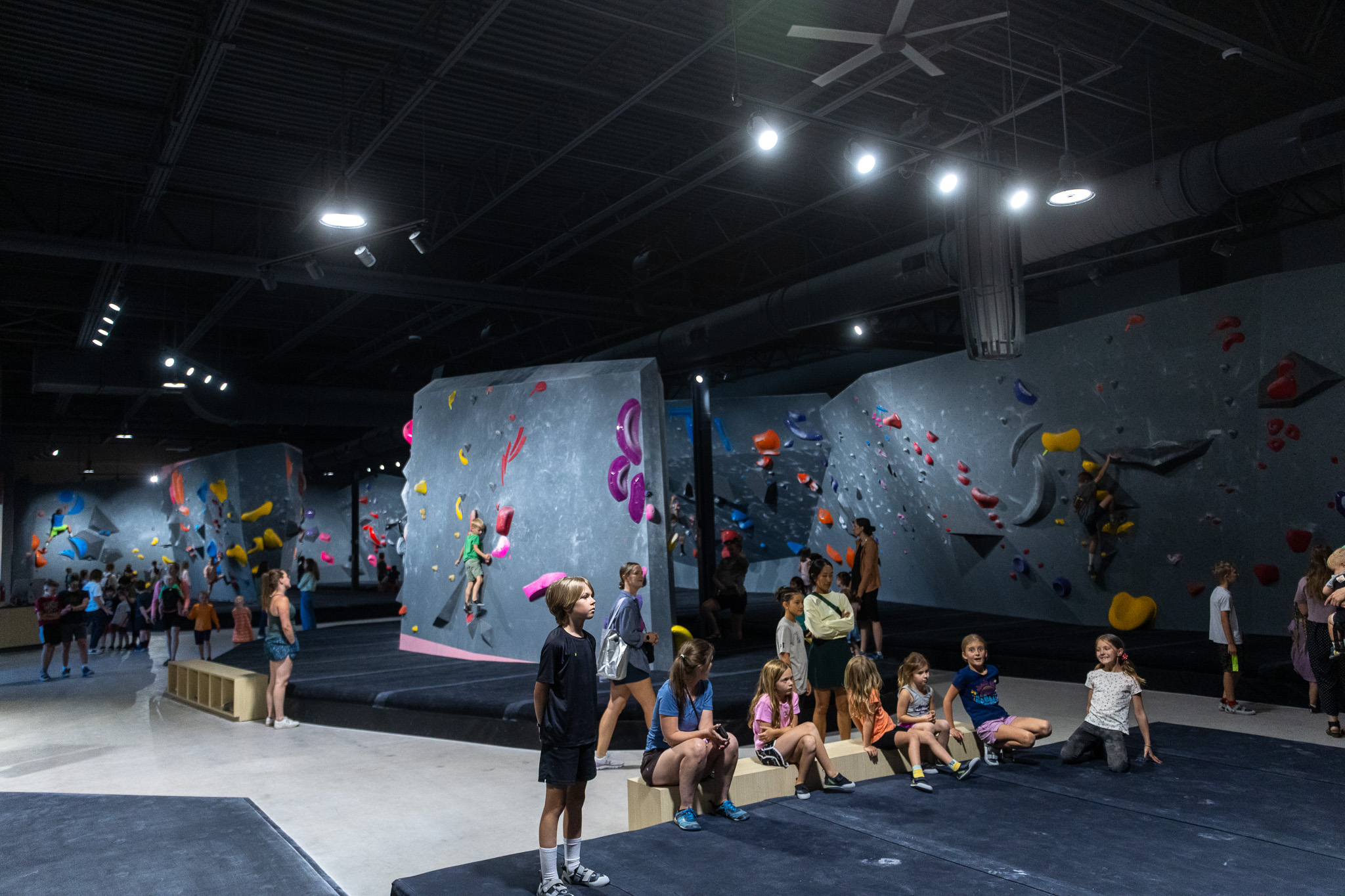
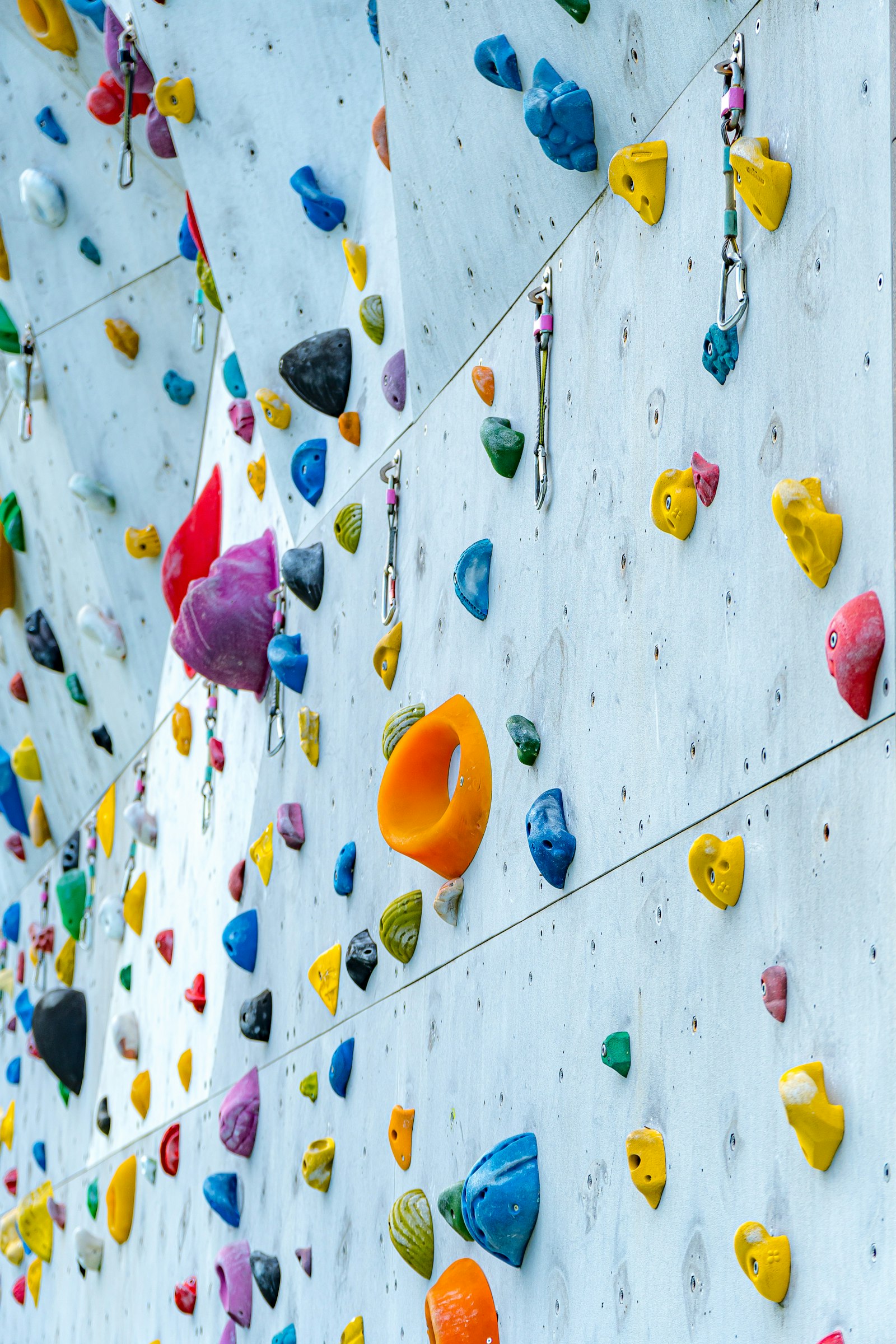
A circuit is a collection of climbs in the same difficulty range, identified by the color of the holds. Instead of hunting for the one V3 in the corner, you find your color and climb everything in it, all over the gym: slab, vertical, the dihedrals and arêtes (inside and outside corners), the tilting boulder, the steep wall. We keep 8 to 10 climbs in each of our four most accessible colors on the wall at all times, so a new climber has 30 or more climbs to finish on day one, and the harder colors run through the whole building too.
Colors do a few things a number can't. They push you onto styles you'd otherwise skip, because "finish every purple" includes the slabby purple and the steep purple. They make progress a count ("I've done seven of the ten pinks") instead of a single number that goes up or doesn't. And they take the comparison out of the mats; nobody is announcing what grade they climb, so the person next to you is just a person working on the same orange. Our exceptional routesetting team, made up of four USA Climbing-certified routesetters, strips, washes, and resets sections every week, so each circuit is a fresh set of puzzles month to month. Here's how they work if you're curious.
Circuit color to V-grade at Shift
So, the map. This is how we think about our own colors relative to the V-scale, and every range is approximate.
| Circuit color | Loose V-grade range | Who tends to live here |
|---|---|---|
| Yellow | Vb (V0-) to V1- | Absolute beginners, kids, your first day |
| Red | V0 to V2 | Second and third visits, building a base |
| Orange | V1 to V3/V3+ | Regulars a few weeks or months in |
| Purple | V3 to V5+ | Intermediate climbers |
| Pink | V4/V4+ to V6+ | Strong intermediates working toward advanced |
| Black | V6/V7 to V7+/V8 | Advanced climbers |
| Blue | V7/V8 and well beyond | Our hardest climbs, open-ended at the top |
| White | Varies by theme | Everyone, depending on what's in rotation |
A few notes on reading that table honestly.
The ranges overlap on purpose. The hardest red is probably harder than the easiest orange, and the top of purple lands somewhere in the middle of pink. We design it that way. A circuit is a range, not a point, and the overlap means there's always a next climb that feels reachable instead of a cliff between colors. If you finish every purple and the first pink feels impossible, try a different pink; the easy pinks are purple-plus, and they're in there.
This is our correlation, not a standard. If you climb V5 at your home gym, you might find our purples easy and our pinks hard, or the reverse. That's not a comment on you or on your gym; it's the V-scale being the V-scale. Use the table to pick a starting color, then let the wall tell you where you actually are.
The top is open. Blue starts around V7 or V8 and keeps going, because our setters like having somewhere to put the hard stuff and our strongest climbers like having a project that lasts. There's no ceiling color above blue.
White: the rotating theme circuit
White is the odd one out, and it's our favorite to set. It isn't a fixed grade band. It's a rotating theme circuit, and the theme changes with each set. Some months white is all dynamic movement (jumping, swinging, catching holds on the move). Some months it's footwork only, with climbs built to punish anyone who tries to pull their way up. Sometimes it's a set of six or seven climbs each built around a different climbing competency (balance, compression, tension, precision, and so on), so that circuiting the whites is a tour of your own weaknesses. And when we host a guest setter, white is often where their signature style shows up.
So the difficulty of white depends entirely on the theme in rotation: one cycle it might sit around the orange and purple range, the next it might have climbs that trouble our black climbers. Ask at the desk what the current white theme is, or just try one and find out. It's the circuit most likely to teach you something you didn't know you were missing.
Using the map on your first visit
If you've never climbed, ignore the table and start on yellow, even if you're strong. Yellow and red are where you learn to trust your feet, find the start, and come down safely, and 30 or more climbs across those first colors is a full afternoon. Everything you need is in our first-visit guide.
If you climb elsewhere, find your usual grade in the middle column, start one color below where it lands, and circuit that color across the whole gym before you move up. A climber who does V4 at home usually starts on orange, finishes it in a session, and then has a very good time on purple. A V6 climber starts on purple, moves to pink, and finds out what our steep wall thinks of their heel hooks.
If you're stuck on a color (or, in grade terms, you can do the V4s but the V5s keep spitting you off), we wrote a whole guide to breaking a climbing plateau using exactly this circuit system, and our Skills Sessions are free with any entry.
V-grades on the Tension Board 2
One place in the building does use numbers: the Tension Board 2. The TB2 is a standardized training board with an app full of problems, and those problems carry grades set by the board's community rather than by us. If you want a number to track month to month, the board is where to get it, and our TB2 explainer covers how it works. On the walls, though, it's colors, and we like it that way.
Questions we get about circuits and grades
What V-grade is each circuit color at Shift?
Loosely: Yellow is Vb to V1-, Red V0 to V2, Orange V1 to V3/V3+, Purple V3 to V5+, Pink V4/V4+ to V6+, Black V6/V7 to V7+/V8, and Blue V7/V8 and beyond. White is a rotating theme circuit with no fixed grade band. The ranges overlap on purpose, and this is our own correlation rather than an industry standard.
Does Shift use V-grades?
Not on the walls. Climbs are organized by hold color into circuits, each covering a range of difficulty. The Tension Board 2 in our training area uses the grades from its app.
Why do the color ranges overlap?
Because a circuit is a range, and we want the hardest climbs in one color to meet the easiest climbs in the next, so there's always a reachable next climb instead of a jump between colors.
What is the White circuit?
A rotating theme circuit. Each set is built around a theme (dynamic movement, footwork only, a tour of six or seven climbing competencies, or a guest setter's style), and the difficulty changes with the theme. Ask at the desk what's in rotation.
Which color should I start on?
Yellow if you've never climbed. If you climb V-grades elsewhere, find your grade in the table above and start one color below it, then work up.
Are the V-grade ranges the same as other gyms?
No two gyms agree on V-grades, and ours are no exception. Use the ranges to pick a starting color and expect to adjust.
Find your color, and if you can't tell which one that is, ask anyone on the mats. Half of them are working on the same question!
