




Every climber hits it. You've been at the gym for six months or three years, you can finish most of one circuit color and almost none of the next, and the "almost" hasn't moved in a while. Your friends are sending things you fall off. You've started skipping the steep wall because it makes you feel like a beginner again. Welcome to the plateau, the most universal experience in climbing and the one nobody warns you about.
Here's what it usually looks like in our building. Perhaps you're climbing in the purple circuit, and every time a new pink circuit goes up you can get one or two of the pinks, but you have a hard time getting the other pinks. If you think in V-grades instead (we don't put them on the wall, but plenty of our climbers carry them in from other gyms), it's the same story: perhaps you feel confident on V4 terrain, but when it gets into V5 or V6 territory you find you can do maybe one in eight of the climbs. Either way you describe it, the wall has stopped moving and you haven't figured out why.
The good news is that plateaus are mostly a variety problem rather than a strength problem, and a gym built for variety has a lot of tools for it. This is how we'd coach you through one at Shift, from cheapest fix to most involved. We'll use color language and grade language interchangeably below, because our colors do correlate loosely with V-grade ranges, and we published that correlation if you want to see where your grade lands.
Signs you've hit a climbing plateau
The pattern is familiar to anyone who's coached for a while:
- You've been "working on" the same circuit color for months, and the count of climbs you can finish in it isn't changing. In grade terms, you've been "a V4 climber" for a year and the V5s still go at about one in eight.
- Certain styles wreck you every time (slab, or compression, or anything steep) while others feel fine.
- Your forearms pump out (fill with blood and stop working) within a few climbs, even on things you know you can do.
- Your feet slip a lot, and you compensate by pulling harder.
- You climb the same handful of problems every session because they're the ones you like.
- You've stopped falling. That one sounds like progress, and it's the opposite: it usually means you've stopped trying things at your limit.
If three of those are you, keep reading.
Causes of a bouldering plateau
Four causes cover most cases, and "you need to get stronger" is rarely the first one.
You only climb at your limit. Intermediate climbers spend whole sessions on two or three projects (climbs at the edge of their ability), get a few good attempts, and go home. That's fine some days, but it's a tiny amount of actual climbing per hour, and technique is built by volume.
You only climb one style or one angle. If you live on the vertical walls because the overhang is scary, or you live on the overhang because you're strong and slab (a wall that leans back, where balance beats power) feels humiliating, your movement vocabulary stops growing. The climbs you can't do are precisely the ones asking for the moves you've avoided.
Your strength and your technique are out of step. Strong climbers with rough footwork muscle through the easy colors (the V0-to-V2 range, roughly) and then hit a wall of climbs that can't be muscled. Technical climbers with no pulling power get stuck on the first color where the holds get small and steep, which for most people is somewhere around purple, or V3 to V4. Both are plateaus; they need opposite fixes.
You're under-recovered. Skin, fingers, sleep, and rest days. Climbing four days in a row on torn tips at 80% is a plateau machine.
Mileage below your limit: circuiting the color under your project
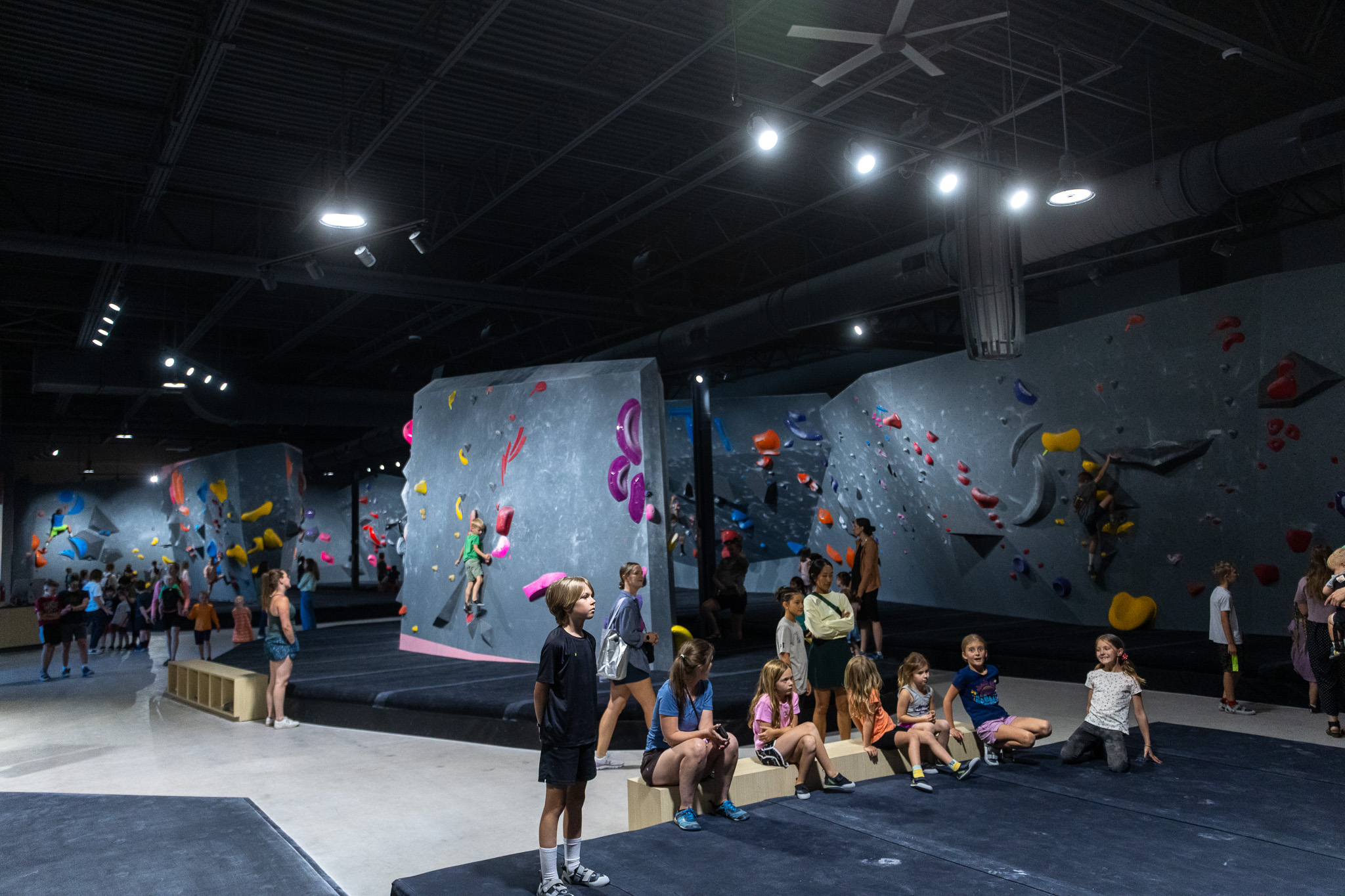
The first fix costs nothing and works on almost everyone. Take the circuit color one step below the one you're stuck on, and circuit it: finish every climb in that color, in every part of the gym, in one session or over two. If you're stuck on pink, that means every purple in the building; if you're stuck at V5, it means every V3 and V4 you can find. Our climbs are organized by hold color into circuits (each color is a difficulty range, easiest colors first), and we keep 8 to 10 climbs in each of our four most accessible colors at all times, with the harder colors running through the whole building too. Circuiting a full color puts you on slab, vertical, the 15-to-25-degree overhangs, the dihedrals and arêtes (inside and outside corners), and the steep wall, all at a difficulty where you can pay attention to your feet instead of surviving.
That's the point. Below your limit, you can climb a problem three times and change one thing each time: quieter feet, hips closer to the wall, a straighter arm. Those changes are what move the next color, and you cannot practice them on climbs you're falling off of. Because our routesetting crew strips, washes, and resets sections weekly, a circuit is never the same set of problems two months running, so the mileage stays interesting. Here's how our setting works if you're curious who's building the puzzles.
Steep terrain at sub-limit difficulty
Here's the fix intermediate climbers resist most, and the one we'd push hardest. Go to the steep wall and climb easy things on it, a lot.
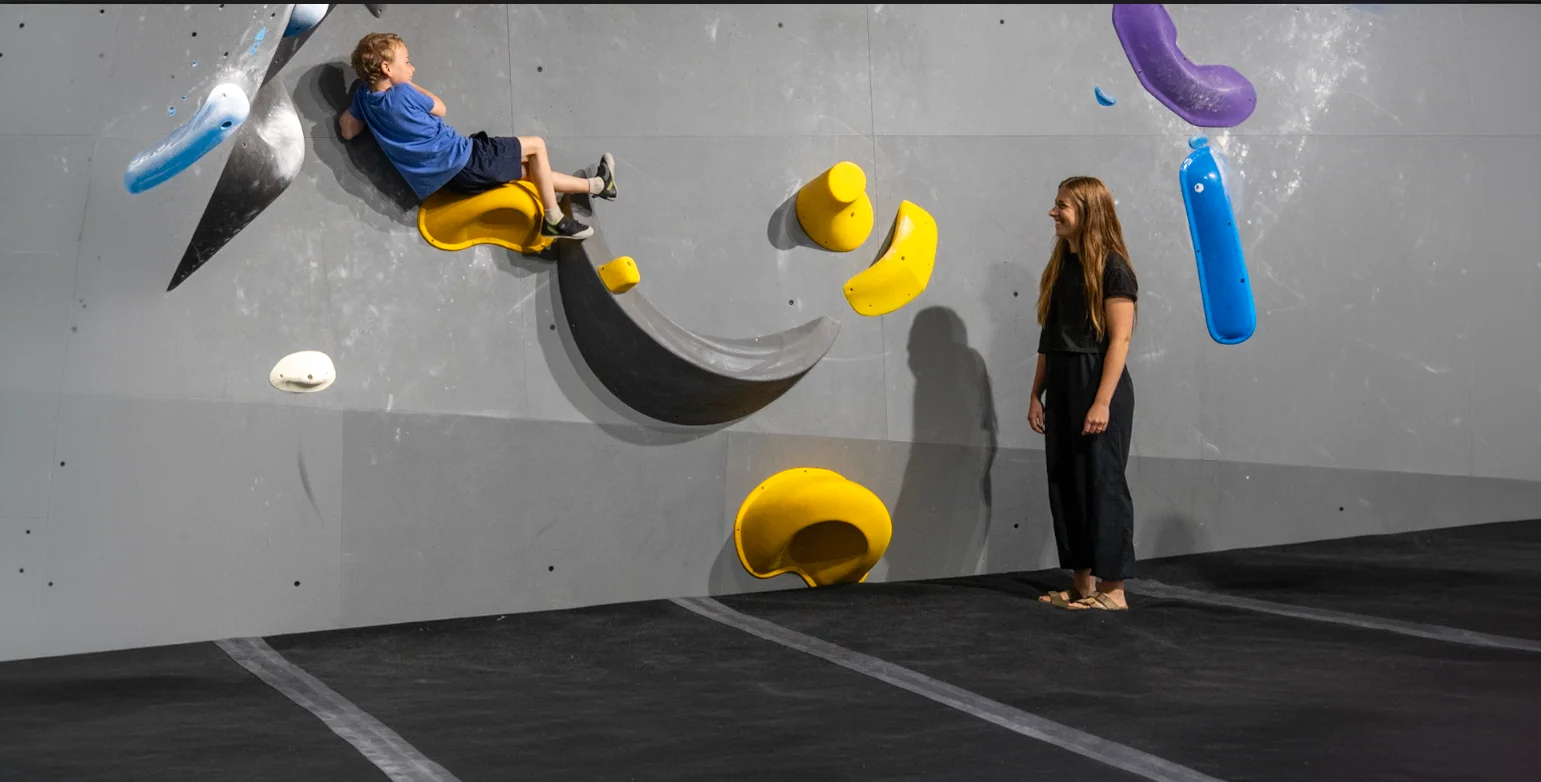
Our overhang is 61.4 feet wide and 16 feet tall, moving from 45 degrees to 60 degrees across two sections, and we set climbs from our most accessible circuit colors on it deliberately, not just hard ones. That width is why: a narrow overhang only has room for a handful of climbs at one difficulty, but sixty-one feet holds a full spread from easy to hard at the same angle, at the same time, so an intermediate climber always has steep climbs one and two colors below their limit to work on. A purple climber has steep oranges and reds; a V5 climber has steep V2s and V3s.
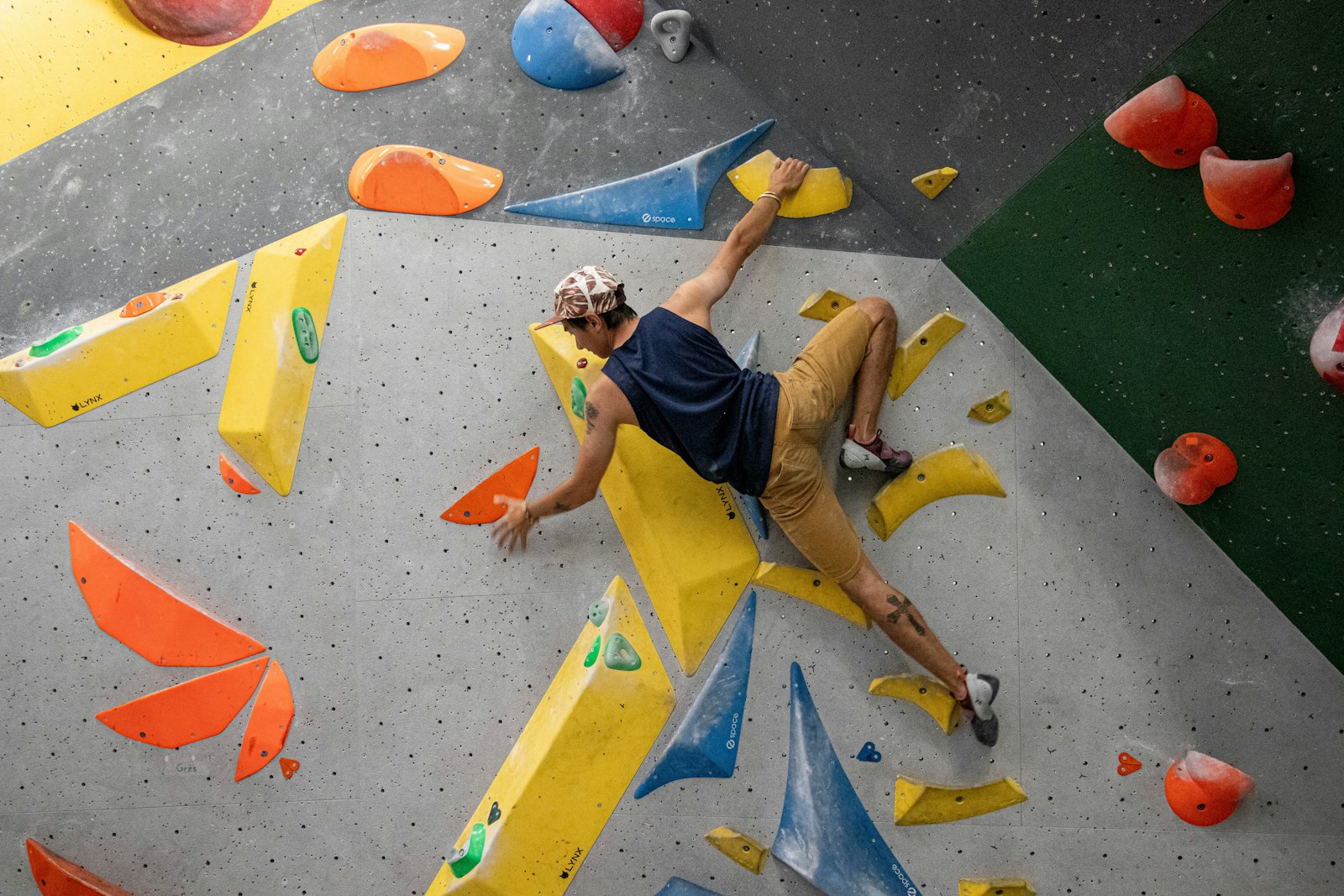
Why does easy steep climbing break plateaus? Because steep terrain won't let you cheat. On a vertical wall you can hang off straight arms and shuffle your feet and get away with it. Lean the wall over your head and your hips, core, and feet have to join in or you swing off. Body tension (keeping your feet on when gravity is pulling them off), toe-hooking, heel-hooking, and moving your hips before your hands are all skills you learn on steep climbs you can finish, and then bring back to the vertical climbs that were stopping you. Ten easy climbs on the 45-degree section teach more technique than one hard project on it.
A note on falling, since it's what keeps people off this wall: on an overhang you fall away from the wall onto flat padding, which at Shift is 12 to 14 inches of engineered foam. A 2025 study of bouldering injuries found that the typical injury scenario is a feet-first landing from a vertical wall, with a much smaller share of reported falls happening on steep terrain. We'll leave the physics there; the point is that steep looks scarier from the ground than it feels on the pads.
Same climb, three angles: the tilting boulder
One of our freestanding boulders is hydraulic. It tilts from vertical to 13 degrees left to 13 degrees right, and we set it to be climbed in all three positions, so the same holds become three climbs. For plateau work it's a laboratory: climb a problem at vertical, tilt it, and feel exactly which move got harder and why. If your feet cut loose the moment the angle changes, that's your feedback, and you don't need a coach to read it. Ask at the desk when the boulder's being tilted; it moves on a schedule and it's worth building a session around.
Board sessions on the Tension Board 2
For the strength side of a plateau, our Tension Board 2 (TB2) is the measured tool: a standardized, adjustable-angle training wall with an app full of benchmarked problems, so you can pick a difficulty, set an angle, and track whether the number moves month to month. We wrote a full explainer on the TB2 and how to use it, so we won't repeat it here.
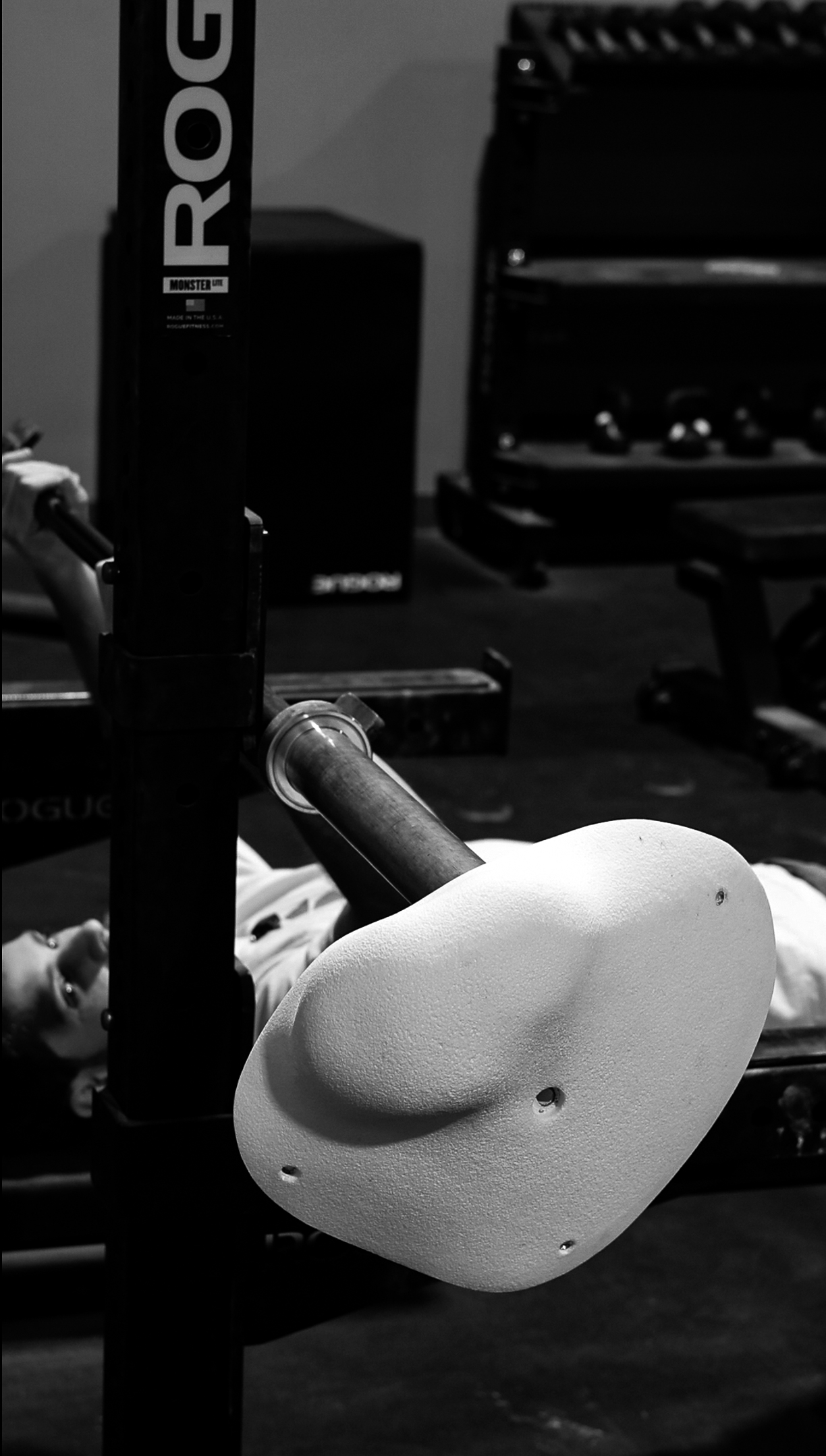
Our coaching view, hedged the way it should be: a board is excellent for pulling power and body tension and terrible for variety, because the holds never change. One short board session a week alongside your circuit mileage tends to help; four board sessions a week instead of climbing tends to produce a very strong climber who's still stuck on the same color. The board is in our dedicated training area alongside a hangboard station and a Rogue fitness zone, all included with any entry.
Coaching: Skills Sessions and private instruction
If you'd like a second set of eyes, the cheapest option here is free. Our Skills Sessions are 60-to-90-minute small-group labs on the wall, led by our setting and coaching staff, completely included in your day pass or membership with no upcharge and no partner required. They're built for exactly this problem: the coach meets you at your current circuit level and points out the shifts in body weight, hip position, and momentum that make the next color click. (If you've never climbed, take Intro to Shift first; Skills Sessions assume you've bouldered a bit.)
For a stubborn plateau, private instruction runs in three phases: a movement diagnostic where your coach watches you on different angles and styles, on-the-wall intervention on your active projects, and a written homework blueprint of drills and circuit strategies to run on your own. You fill out a short goals questionnaire and a member of the instructional team reaches out within 24 to 48 hours to schedule.
Climbing with people who are better than you
The least technical fix on this list might be the most effective. Wednesday nights are Circuit Labs, a gym-wide session open to every level, and it's the easiest place in the building to end up trading beta (climber-speak for how a problem is solved) with someone two colors (or two or three V-grades) above you. Watching a stronger climber do your project, then trying their sequence, is a faster lesson than any drill. Because our walls have no grades on them, only colors, nobody's comparing numbers, and the mats stay friendly. Ask someone on the pads next to you how they did the move; that's the whole culture here.
Rest, skin, and fingers
Recovery is the boring fix and the one most intermediate climbers skip. Two or three sessions a week with a full day between them beats five sessions of tired climbing. Skin matters more than people think: split tips change how you grip, which changes how you move, and you can plateau for a month on nothing but bad skin. File calluses, stop a session when a tip opens, and let it close.
Fingers deserve their own line. If a finger joint hurts in a way that lingers into the next day, back off small holds for a while and let it settle; a plateau is a bad reason to pick up a finger injury that costs you a season. For climbers still growing, this is firm rather than advisory: a 2025 scoping review of adolescent sport climbers found finger growth-plate stress injuries to be the most common injury in that age group, tied to intensive loading on small holds, and it's why our youth programs keep kids off intensive small-hold training entirely. Teenagers stuck on a color should get the mileage and steep-terrain fixes above, not the hangboard.
A four-week plateau plan you can run at Shift
Here's one way to put all of that together, assuming three sessions a week. Adjust to your calendar; the shape matters more than the days.
Session A: mileage. Circuit the color below your project (a grade or two under your limit, if you think in numbers) across the whole gym, steep wall included. Climb everything twice, changing one thing on the repeat. Finish with fifteen minutes on the 45-degree section at easy difficulty, feet only, no pulling harder than you have to.
Session B: limit. Two or three projects in your target color or grade, with long rests (three to five minutes between real attempts). Pick at least one on steep terrain and one in a style you avoid. Stop when your attempts get sloppy rather than when you're wrecked.
Session C: skills. A Skills Session if one's on the calendar, otherwise a short TB2 session at a moderate angle followed by twenty minutes of easy climbing on the tilting boulder in whichever position it's in. Once a week here is plenty.
Rest days between sessions, and one full weekend off somewhere in the four weeks. At the end, circuit your target color and count what you can finish, or, in grade terms, see whether the V5s go at three in eight instead of one. If the number moved, you've broken the plateau. If it didn't, come find one of us on the floor; that's what the coaching staff is for, and the first conversation is free with your entry.
Questions we get about climbing plateaus
How long does a climbing plateau last?
There's no fixed answer, and anyone giving one is guessing. Plateaus commonly run weeks to months, and the ones that last longest are the ones where the climber keeps doing the same session. Changing the mix (mileage below your limit, steep terrain at easy difficulty, a coaching session) is what shortens them.
Should I train on a board to break a plateau?
Sometimes. A board like our TB2 builds pulling power and body tension measurably, which helps if strength is the missing piece. If technique is the missing piece, a board can make the plateau worse by adding strength you can't use. One short board session a week alongside circuit mileage is our usual suggestion; the TB2 explainer covers how to use it.
Does steep climbing help intermediate climbers?
In our experience, more than anything else in the gym, provided there are easy climbs on the steep wall to learn on. Our 61.4-foot overhang runs 45 to 60 degrees and always has climbs from our most accessible colors set on it, so an intermediate climber can build body tension and footwork at a difficulty they can finish.
Do I need a coach to break a plateau?
No, but it's the fastest route. Our Skills Sessions are free with any entry and built for this exact problem, and private instruction is there for the stubborn cases. Most plateaus also respond to the free fixes above: more volume below your limit and more steep terrain.
Does Shift grade climbs?
No, not necessarily. Our climbs are organized into color circuits rather than V-grades, inspired by the bouldering circuits of Fontainebleau, France. However, we do find that the colors in our circuit system certainly correlate with a range of V-grade difficulty, and we published our loose color-to-V-grade map for anyone who wants to translate. For plateau work the colors are a feature: your progress is "I finished nine of ten in that color" rather than a number, and nobody on the mats is comparing.
Plateaus are our favorite problem to solve, because we get to solve them standing on the mats next to you. Find any of us on the floor and bring your psych!
