





Run a climbing gym for a while and you start to notice who walks in. At Shift, the crowd between about eighteen and thirty-five leans a particular way: people who like to figure things out, who'd rather study a problem than be told the answer, and who are, on the whole, a little more introverted than the folks you'd find at a Tuesday-night rec league. We see the same thing in a lot of the kids in our youth programs. Plenty of them tried soccer or basketball or baseball, gave it an honest go, and never quite clicked. Then somebody brought them here and something landed.
That's an observation from our front desk, not a census, and we want to be careful about the difference. So this post does two things. It lays out what we see, and it lays out what the actual research says about climbing, problem-solving, introversion, and kids who never found their sport, with links to every source so you can read them yourself. Where the evidence backs up our hunch, we say so. Where it doesn't exist yet, we say that too.
A puzzle first, a workout second
Here's the thing most people don't know until they try it: in bouldering, a climb is called a "problem." That's the actual term. A boulder problem is a short sequence of holds, a few moves long, and before you touch the wall you stand on the mat and read it. Which hand goes where? Do you turn your hip in or stay square? Is that foothold for pushing or for balance? Climbers call this the preview, and it's where a surprising amount of the sport happens.
Researchers have measured it. In a 2021 study in PLoS One, Jerry Medernach and Daniel Memmert gave 77 boulderers of different levels four minutes to preview problems and then tracked how they climbed. Advanced climbers needed less time to decide on a plan and made fewer movement mistakes on the wall, and the authors concluded that "accomplished decision-making abilities consist of a key determinant in successful indoor bouldering performances." Strength matters, obviously. But the study's point is that the sport rewards people who read well and plan well, which is a different skill from being the fittest person in the room.
The mental side of climbing has been noticed by psychologists for a long time. When Mihaly Csikszentmihalyi was developing the idea of "flow" in the 1970s, rock climbers were one of the groups he interviewed for Beyond Boredom and Anxiety, and he was a climber himself, having taken it up as a teenager in the Dolomites. It's worth being honest about what he found, though: only nine of the 30 climbers he interviewed consistently reported flow, and a few of them told him the whole idea was nonsense. Climbing doesn't put everyone in a trance. What it reliably does is demand your attention, because the wall doesn't care what else is on your mind. Professional climber Hazel Findlay put it plainly to Newsweek last year: "Climbing engages the brain as well as the body, which keeps us present and focused."
Introverts at the climbing gym, by the numbers
Our sense that climbers run introverted turns out to have some real data behind it. In 2025, a team from Rowan University published a survey of 748 climbers in the journal Discover Mental Health. Half the respondents were 26 to 40, indoor bouldering was the most common discipline, and when asked about their own temperament, 46.8% described themselves as introverts and another 37.1% as ambiverts. Only 16% called themselves extroverts.
Now the part we find genuinely interesting. Despite that, 74.1% of the same respondents said they engaged socially during their climbing sessions, and 73.1% said climbing had a positive effect on their mental health. The authors' read was that "the nature of rock climbing gyms may foster environments that enhance the social nature of introverts." We'll come back to why that might be, because we think we know.
A caveat, since we promised honesty: this was a self-selected online survey, so it tells you about the people who chose to answer, not about every climber in America. The other personality study we could find points the same general direction with more nuance. A 2021 paper in Psychology of Sport and Exercise profiled 331 competitive climbers on the Big Five personality traits and found four distinct types. The single largest group, about a third of the sample, was what the authors called "Measured and Compliant": lower-to-moderate on extraversion, higher on conscientiousness and agreeableness. Careful, steady, cooperative people, in other words. But roughly one in five climbers fit a "Healthy" profile that scored high on extraversion, and the rest landed in between. Climbers are not one personality. They do seem to include a lot of people who'd rather think than talk.
Engineers, programmers, and the climbing gym
This is the part of Jack's observation we couldn't find a study for, so we'll be upfront: nobody has published a peer-reviewed count of climbers by occupation, and we found no research linking climbing to engineering aptitude or STEM careers. What exists is journalism and a lot of people noticing the same thing.
The best-reported version is a 2023 piece from Mission Local about Mission Cliffs in San Francisco, where, by the article's account, at least half of the gym's roughly 900 daily visitors work in tech, and the evening rush is engineers, data analysts, and developers from Google, Adobe, Tesla, and a pile of startups. The writer's explanation is the one we'd give: routes are "literally called 'problems'," and the sport hands an analytical mind a fresh, physical puzzle every time a wall gets reset. One Google employee told the reporter, "It's another techie hub, but I like it."
We're a bouldering gym in Holland, Michigan, not the Mission District, and our version is smaller and lower-key. But we do see the pattern: a lot of engineers from the manufacturing companies along the lakeshore, a lot of people who work in software, a lot of students who'd describe themselves as "not a sports person" and then spend two hours staring at a purple problem until it goes. That's our observation. Take it as one gym's experience, because that's what it is.
Solo climbing inside a community
Here's what we think explains the introvert numbers, and it comes down to how a bouldering gym is built.
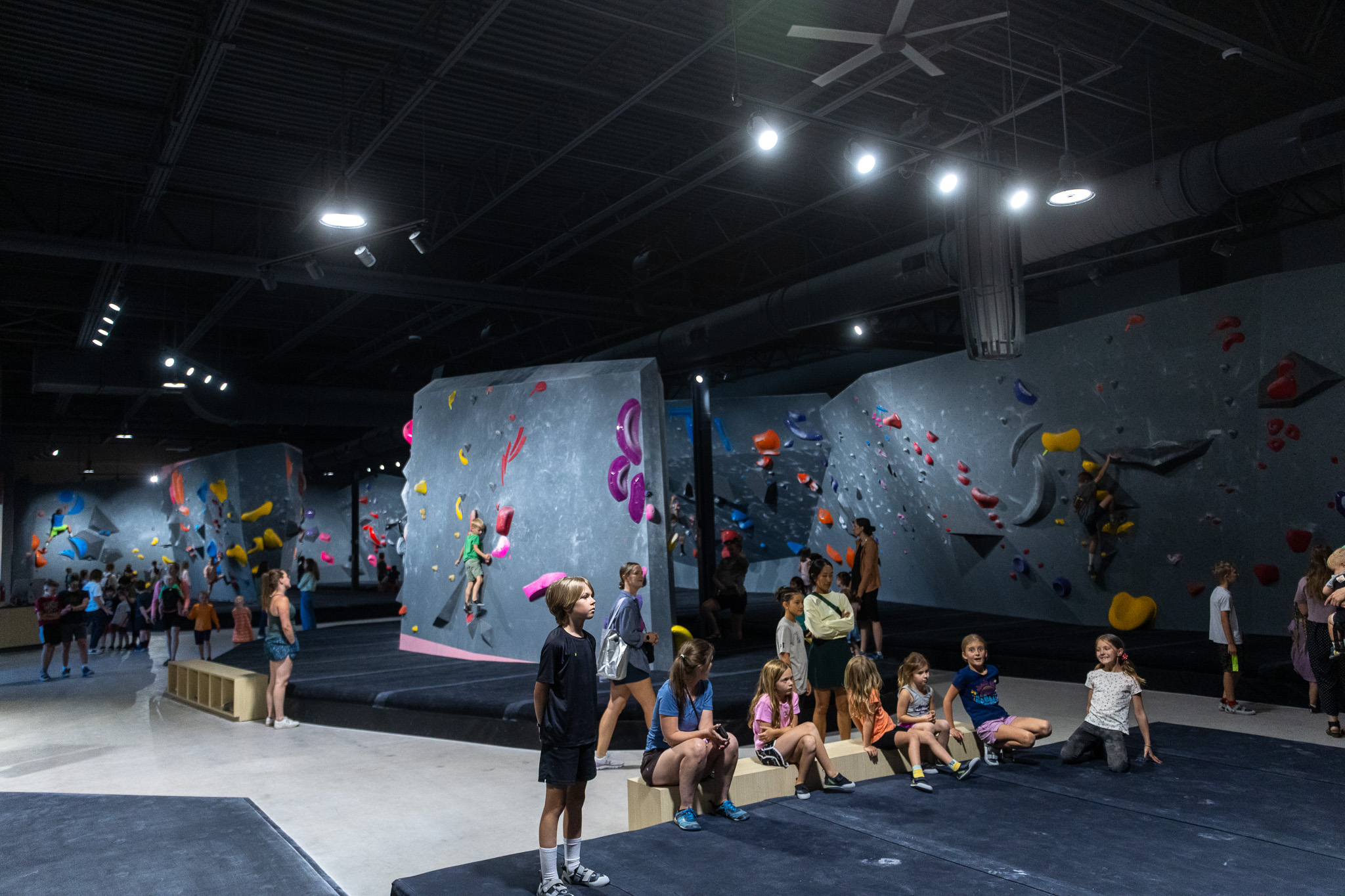
Bouldering needs no partner. There are no ropes, no harness, and nobody has to hold the other end of anything. You can walk in alone at 6 AM on a Tuesday, climb for an hour, and leave without saying a word to anyone, and that's a completely normal way to use the gym. For a lot of people, that's the whole reason they came in the door.
But something happens on the mats. You sit down after falling off a problem, and the person next to you just fell off the same one. There's an immediate, low-stakes, useful thing to talk about, and it isn't small talk. "Did you try the heel hook?" is a real question with a real answer. Mission Cliffs' coach Nick Stroup described it well: "You're sharing space with people, you watch them do something that you're trying to do." Nobody has to introduce themselves. The problem does the introducing, and the conversation ends naturally when someone gets back on the wall. If you've ever found parties exhausting but a good conversation about a shared project energizing, you already understand why a climbing gym works for you.
One of our members, Mika, said it better than we can on her story page: "I actually lived here in Holland before. I struggled a lot. I didn't have many friends. And I moved out of state and I came back with climbing as part of my life. I love climbing at SHIFT. I feel welcome. Everyone knows me here. I know everyone." Or Aidan, who came to climbing after losing his best friend: "Every time I walk in, I don't have to tell the front desk my name to get signed in." That is what "find your people" means to an introvert. Not a crowd. A handful of familiar faces and a shared puzzle.
Kids who haven't found their sport yet
Now the kids, because this is where parents write to us.
The youth sports numbers are sobering on their own. The Aspen Institute's Project Play surveyed 3,827 kids ages 10 to 17 at the end of 2025 and found that former players had quit at an average age of just under 13. Their top reasons for disliking the experience were feeling "I'm not good enough" (29%) and bad coaching (21%). Kids who were still playing said the best parts were "having fun" (48%) and "playing with friends" (47%); only 12% cared about a college scholarship. An earlier Project Play survey found the average child sticks with a given sport for under three years, and that when they quit, the most common reason (36% of the time) was simply that they stopped enjoying it.
The research literature agrees. A 2022 meta-analysis in Frontiers in Psychology found enjoyment was the strongest predictor of whether kids kept playing, and that "lack of enjoyment was the main reason for dropout." Amanda Visek's Fun Integration Theory, built from interviews with 142 young players plus their parents and coaches, mapped 81 different things kids mean when they say a sport is "fun." Very few of them are about winning.
So when a kid tells you soccer "isn't fun," they may be telling you something specific. Maybe they never got the ball. Maybe they sat on the bench. Maybe the pressure of letting eleven other kids down every time they missed was more than the game was worth. The pediatric advice from Nemours KidsHealth on kids who don't like sports is to "give some honest thought to your child's strengths, abilities, and temperament, and find an activity that might be a good match," and to remember that "even if team sports never thrill your child, there's plenty a kid can do to get the recommended 60 minutes or more of physical activity each day." (That page lists swimming, martial arts, gymnastics, and a dozen others, and doesn't mention climbing. We'd like a word with them.)
Here's why we think climbing so often ends up being the thing for these kids. There's no bench and no ball. Nobody's turn gets taken. A kid who is small, or cautious, or takes a minute to warm up to a group can pick a problem, work it at their own pace, and get an unambiguous "yes, you did it" when they top out, without anybody else's result depending on theirs. Our climbs are organized by color rather than by number grades, a system borrowed from the bouldering circuits of Fontainebleau, France, so progress is visible ("I did a red!") without ever becoming a ranking. And the kid who thinks before moving, who wants to understand the puzzle before committing, isn't slow here. They're doing it right. One of our adult members, Nathaniel, came from martial arts and described the appeal exactly: "Climbing forces you to be intentional with your movement, intentional with the amount of effort you put in." Eleven-year-old Asher, in our homeschool program, put it in kid terms: "They challenge me in a very good way. Like, makes me feel like I want to do it again."
Team sports vs. individual sports: reading the research honestly
We'd be cheating if we stopped there, because the biggest study on this question doesn't flatter individual sports, and you deserve to know about it.
In 2022, researchers analyzed data on 11,235 American kids ages 9 to 13 from the ABCD Study and found that kids in team sports had fewer parent-reported mental health difficulties than kids in no sport at all (about 10% lower anxiety and depression scores, 19% lower withdrawn scores), while kids who played only individual sports had somewhat higher scores than kids who played nothing (16% higher anxious/depressed, 14% higher withdrawn/depressed). The individual sports in that dataset were gymnastics, tennis, wrestling, dance, martial arts, swimming, and horseback riding. Climbing wasn't one of them.
The authors were careful about what this means, and so should we be. The study was a snapshot, so it can't say which way the arrow points; as they wrote, "we cannot make causal claims." Their own suggested explanation was that kids who are already struggling socially may be steered toward individual sports in the first place, and that parents of those kids may rate them more harshly. The effects were small. But the finding is real, and it's a fair warning against the idea that pulling an anxious kid out of every group setting is automatically good for them.
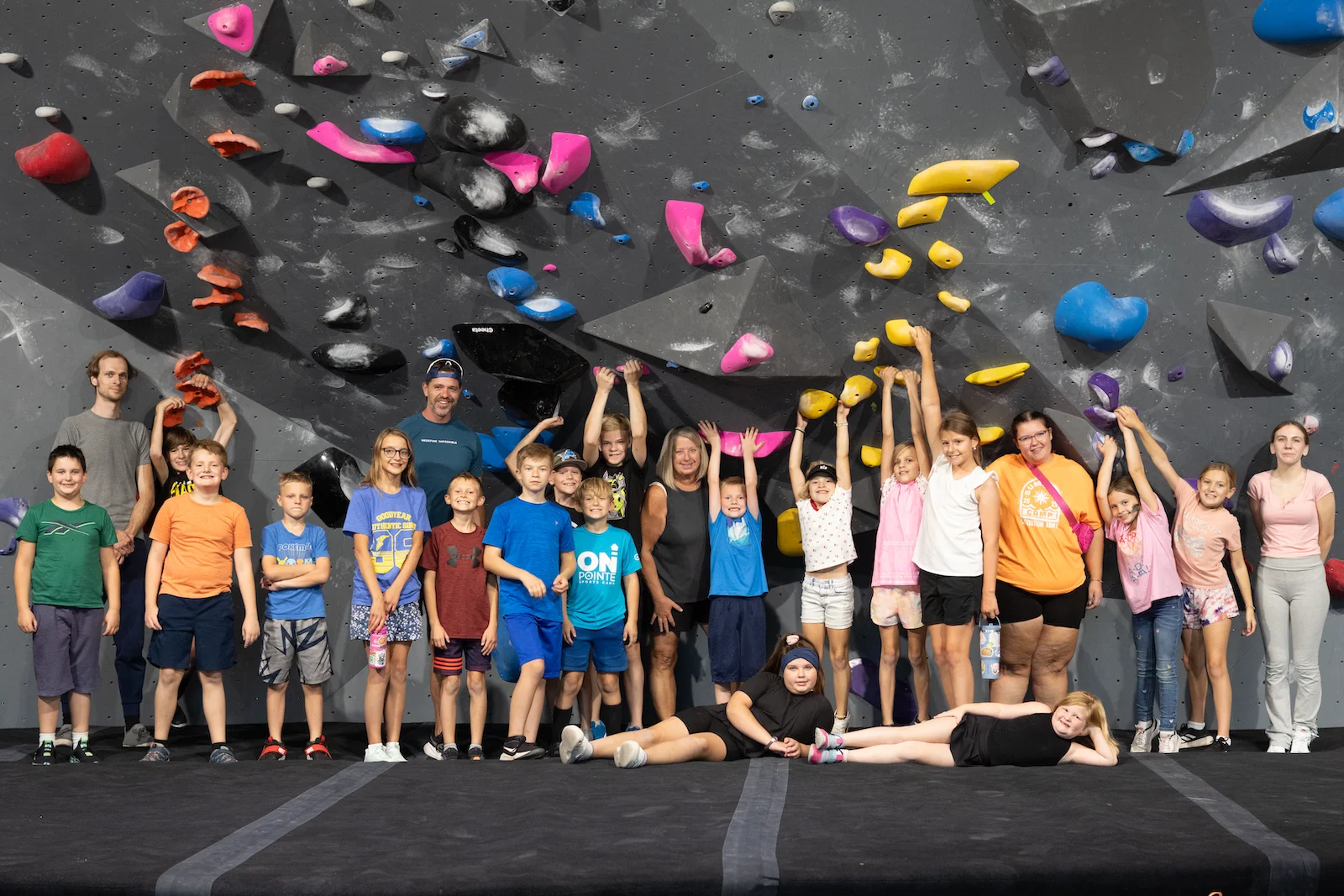
What we take from it is this: the goal for a kid who doesn't fit team-sport culture isn't isolation. It's an activity where the challenge is individual and the room is shared. That's a pretty exact description of a bouldering gym. The problem is yours alone. The mat under it has six other kids on it, all failing and succeeding at their own things, cheering when somebody sends. Our afterschool program for ages 7 to 13 runs on that principle, with a coach on the floor and a group of kids, but no lineups, no positions, and no score.
Neurodivergent kids and climbing
Parents of kids with ADHD or autism ask us about climbing often enough that we looked hard at the research. The honest summary is "early and promising, but thin."
A 2025 systematic review in BMC Sports Science, Medicine and Rehabilitation found only five controlled trials of therapeutic climbing for young people, covering groups from psychiatric inpatients with depression, ADHD, and eating disorders to adolescents in Lebanon. The trials reported improvements in "overall mental health, psychological distress, self-efficacy, alienation, and affective and emotional states," but the reviewers were blunt about the limits: small samples, few high-quality designs, and no clear evidence that climbing does anything a different sport wouldn't. One small US pilot ran an adapted climbing program for five kids ages 8 to 13 with ADHD and saw attention improve within sessions, though the parent-rated behavior changes weren't statistically significant. Five kids is five kids.
So we won't tell you climbing treats anything, because Shift is a gym and not a clinic. What we can tell you from experience is that a lot of kids who find noisy team environments hard do well on our floor. The task is concrete, the feedback is instant, and the environment is calmer than a gymnasium because the sound of a bouldering gym is mostly people thinking. If your kid has specific sensory or supervision needs, call us before you come and we'll talk through a good first visit.
Bouldering in the therapy room
One more body of research is worth knowing about, because it's the strongest evidence that the puzzle part of climbing does something real for the brain. Over the past decade a group of German psychiatrists has run a series of randomized trials on what they call bouldering psychotherapy for adults with depression. In a 2020 trial of 133 outpatients, ten weeks of group bouldering therapy cut depression scores by 8.4 points versus 3.0 points for a home exercise program. A follow-up trial with 156 patients found bouldering therapy was not inferior to standard cognitive behavioural therapy, with both groups moving from moderate to mild symptoms. And a 2026 trial in BMC Medicine with 128 adults again found bouldering therapy beat treatment as usual.
Why bouldering rather than, say, running? The researchers built their program around exactly the things this post is about: problem-solving, focus in the moment, the confidence that comes from doing something you didn't think you could, and the easy social contact of a shared wall. We are not offering therapy, and if you're struggling please talk to a professional. But if you've ever wondered whether "climbing clears my head" is a real effect or just a nice feeling, there are now several randomized trials suggesting it's real.
Shift, set up for this kind of climber
We didn't design our gym with a personality test in hand, but a lot of what we built happens to suit the reader of this post, so here's the plain list.
- You can come alone. Bouldering needs no partner, a day pass is $24 with shoes and chalk included, and there's no class you have to take first. We open at 6 AM on Tuesdays and Thursdays if you like the gym before it fills up.
- There are always problems you can solve. We keep 8 to 10 climbs in each of our four most accessible circuit colors at all times, which is 30 or more climbs a first-timer can finish today, reset weekly. Progress is by color, so nobody asks what grade you climb.
- There's a quiet table. Our café is a co-working space with Madcap espresso, and it is completely acceptable to climb for forty minutes, work for two hours, and climb again. Plenty of our members do.
- The staff will learn your name. That isn't a slogan; it's the most common thing our members say about us, and for an introvert it's the difference between a gym and a home.
- For kids, there's a door that isn't a tryout. Our afterschool program is for ages 7 to 13, our homeschool program runs in daytime blocks starting at age 7, with a teen-focused block for 13 and up, and every Friday and early-release day the middle and high school meet-up gives grades 6 through 12 the whole gym for a $5 day pass, no registration, just show up. Kids under 14 climb with a parent or chaperone on the floor; 14 and up can come on their own.
- If you'd rather learn the rules before you play, our 60-minute Intro to Shift class covers how to fall, how to read the circuits, and how the gym flows, so nothing on the floor is a surprise.
Questions we get about climbing for introverts and non-team-sport kids
Is climbing a good sport for introverts?
The best available data says yes. In a 2025 survey of 748 climbers, 46.8% described themselves as introverts and 37.1% as ambiverts, yet 74.1% said they socialized during sessions. Bouldering needs no partner, so you can climb alone, and the shared problem gives you something concrete to talk about when you want to.
Is bouldering good for kids who don't like team sports?
We see it work constantly, and the reasons make sense: no bench, no ball, no one else's result riding on yours, and visible progress by color rather than by score. Be aware that the largest study on the topic found team sports associated with better parent-reported mental health than individual sports overall, so the aim is an individual challenge in a shared room, which is what a bouldering gym is, rather than isolation.
Do I need a partner to boulder?
No. Bouldering has no ropes or harnesses, so there's nothing for a partner to hold. You walk in, warm up, and climb.
Do engineers really like rock climbing more than other people?
Nobody has counted, so we can't prove it. Reporting from tech-heavy cities describes gyms where half the visitors work in tech, and our own gym in Holland sees a lot of engineers and software people. The likely reason is that a boulder problem is a physical puzzle that rewards planning, and it's literally called a "problem."
Is climbing good for kids with ADHD or autism?
The research is early: a 2025 review found only five controlled trials, all small, with promising but not conclusive results. Many kids who struggle in noisy team settings do well on our floor because the task is concrete and the feedback is immediate. We're a gym, not a clinic, so call us first if your child has specific needs and we'll plan a good first visit.
At what age can a kid start climbing at Shift?
Coached programs start at age 7 with our afterschool program, and kids of any age can climb with a parent or chaperone actively on the floor; from 14 up they can climb on their own. Our Friday teen meet-up is for grades 6 through 12.
If you read all of this and thought "that sounds like me" or "that sounds like my kid," come in. Nobody will make you talk to anyone. But you'll probably end up talking about a purple problem with a stranger anyway, and that's how most of our friendships here started. Here's what to expect on a first visit.
Sources cited in this post
- Medernach, J. P., & Memmert, D. (2021). Effects of decision-making on indoor bouldering performances. PLoS One.
- Chen, K., et al. (2025). Scaling new heights: a prospective survey of rock climbing's impact on mental health. Discover Mental Health.
- Rumbold, J. L., et al. (2021). Examining profiles of the big five and sensation seeking among competitive climbers. Psychology of Sport and Exercise.
- Karg, N., et al. (2020). Bouldering psychotherapy is more effective in the treatment of depression than physical exercise alone. BMC Psychiatry.
- Luttenberger, K., et al. (2022). Bouldering psychotherapy is not inferior to cognitive behavioural therapy in the group treatment of depression. British Journal of Clinical Psychology.
- Kornhuber, J., et al. (2026). Trial of WISE-therapy and bouldering psychotherapy for depression. BMC Medicine.
- Kaar, C., Frühauf, A., & Kopp, M. (2025). The role of therapeutic climbing in child and adolescent mental health: a systematic literature review. BMC Sports Science, Medicine and Rehabilitation.
- Angelini, E., et al. (2020). The impact of an adapted climbing program on children with ADHD. International Journal of Physical Education, Fitness and Sports.
- Hoffmann, M. D., et al. (2022). Associations between organized sport participation and mental health difficulties: data from over 11,000 US children and adolescents. PLoS One.
- Aspen Institute Project Play (2026). National survey of youth and sports: 15 key findings; and (2019) Kids quit most sports by age 11.
- Visek, A. J., et al. (2015). The Fun Integration Theory. Journal of Physical Activity and Health.
- Zhang, Wang & Shao (2022). Predictors of persistent participation in youth sport: a systematic review and meta-analysis. Frontiers in Psychology.
- Nemours KidsHealth. Fitness for kids who don't like sports.
- Zhou, Y. (2023). Dangling in the air at Mission Cliffs, techies find community. Mission Local.
- Tostevin, M. (2025). How rock climbing builds muscle, mindfulness and community. Newsweek.
- University of Chicago Magazine. What's in a game? (on Csikszentmihalyi's 1975 climber interviews); Mayfield, P. (2022). A Climber We Lost: Mihaly Csikszentmihalyi, Climbing.
